
- What is Overseas Direct Investment (ODI)?
- The 10% Rule: Difference Between ODI and OPI
- Who Can Do Overseas Direct Investment from India?
- Main Ways to Do Overseas Direct Investment
- Step-by-Step Process of Overseas Direct Investment
- Sectors Where ODI is Not Allowed
- Why Should Indian Companies Invest Abroad?
- Overseas Direct Investment Limits 2026
- Difference Between ODI and FDI
- Frequently Asked Questions on FDI
- Understanding the Full Picture
- Final Words
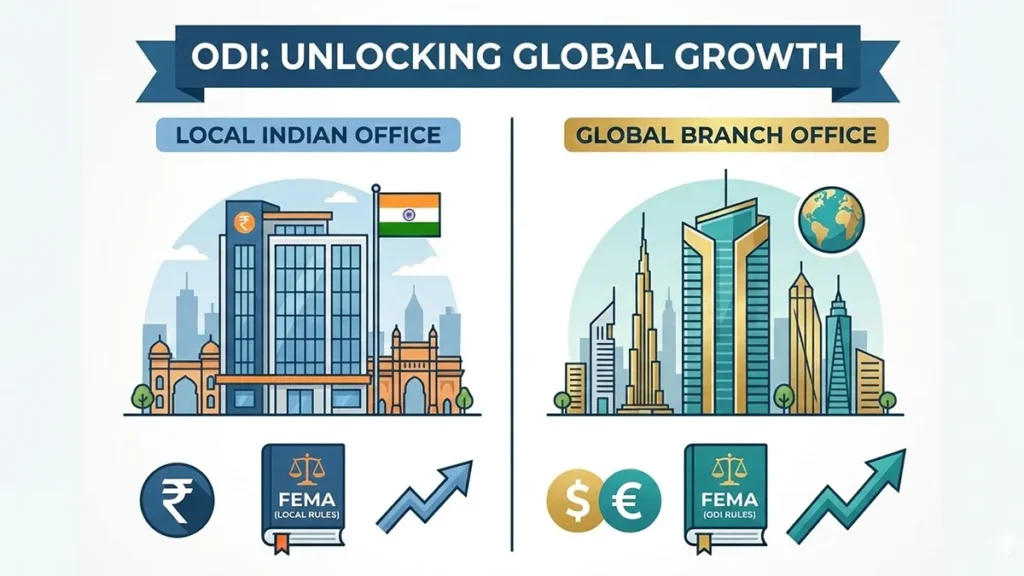
The Indian economy is growing fast. Now, many Indian companies want to grow their business outside India as well. They want to expand into other countries. This is called Overseas Direct Investment (ODI).
A tech startup might target Silicon Valley. A factory might expand its work in Dubai. Overseas Direct Investment helps in this kind of global expansion.
However, the rules are not simple. They include FEMA rules and RBI rules. This is why many investors find the process difficult. This guide explains Overseas Direct Investment in simple language for 2026. This will help your foreign expansion stay legal and help you earn profits.
What is Overseas Direct Investment (ODI)?
Overseas Direct Investment means an Indian person or company invests in a foreign company. The goal is to get control or a strong influence over that company.
It is also called Outward Direct Investment. It is not a regular or small investment. It involves putting in capital, signing agreements (Memorandum), or buying shares. Usually, the stake in the foreign company is 10% or more.
The Foreign Exchange Management Act (FEMA) controls these investments, and the Reserve Bank of India (RBI) monitors them. This ensures that India’s foreign exchange reserves are managed correctly.
The 10% Rule: Difference Between ODI and OPI
Many investors get confused between ODI and Overseas Portfolio Investment (OPI). New RBI rules make this difference clear. This difference is mainly based on control and the size of the stake.
| Feature | ODI | OPI |
| Stake Size | Usually 10% or more of paid-up capital | Less than 10% of paid-up capital |
| Control | Investor has control or strong influence | This is a passive investment; no control |
| Goal | Strategic growth and getting resources | Financial gain and spreading risk |
| Reporting | More rules to follow (Form ODI Part I & II) | Fewer rules required |
Who Can Do Overseas Direct Investment from India?
Many Indian business owners ask—”Who is eligible for ODI?” According to current rules, the following Indian entities can invest:
- Companies: Any company registered under the Indian Companies Act.
- Partnership Firms: Registered under the Indian Partnership Act, 1932.
- LLPs: Registered under the LLP Act, 2008.
- Resident Indian Individuals: Can invest under the Liberalised Remittance Scheme (LRS).
If you are looking for alternative ways to grow your wealth before expanding globally, you might consider how to invest in copper in India to diversify your local portfolio.
Main Ways to Do Overseas Direct Investment
The RBI provides two main paths to send money abroad:
1. Automatic Route
This applies to most businesses.
- An Indian entity can invest up to 400% of its net worth.
- You do not need prior permission from the RBI for this.
- You can invest through your Authorized Dealer Bank (AD Bank) if you have the right documents.
2. Approval Route
If the investment is more than 400% of the net worth or if the business is in a sensitive sector, special permission from the RBI is necessary. This process also happens through the Authorized Dealer Bank.
Step-by-Step Process of Overseas Direct Investment

To remain compliant with the Latest RBI Circular on Overseas Direct Investment (External Link), you must follow a strict reporting cycle:
- Getting a UIN: A Unique Identification Number is necessary for every investment.
- Remittance Reporting: You must fill Form ODI Part I when sending money abroad.
- Post-Investment Reporting: Use Form ODI Part II for share swaps or bonus shares.
- Annual Performance Report (APR): This must be submitted every year by December 31.
Sectors Where ODI is Not Allowed
Indian money cannot be invested in the following areas:
- Real estate business (except for development or leasing).
- Any kind of gambling.
- Banking business (without special RBI permission).
Why Should Indian Companies Invest Abroad?
ODI is not just about spending money; it is a strategic decision.
- Market Expansion: Increasing customers in new countries.
- Getting Resources: Getting raw materials or new technology.
- Spreading Risk: Spreading risk across different countries.
- Brand Building: Creating a global identity.
Overseas Direct Investment Limits 2026
- Corporates (Automatic Route): 400% of Net Worth.
- Indian Residents (LRS): $250,000 per financial year.
- Approval Route: Any amount above the set limits.
Difference Between ODI and FDI
People often mix up ODI and Foreign Direct Investment (FDI).
- In FDI, foreign money comes into India.
- In ODI, Indian money goes to foreign countries.
- ODI is also called OFDI. Both are important for the economy, but FEMA reporting rules are different.
Frequently Asked Questions on FDI
What is Overseas Direct Investment
It is an investment made outside India with a goal of 10% or more stake or control.
Can I invest through an AD Bank?
Yes. The Authorized Dealer Bank is the bridge between the investor and the RBI.
What is the difference between FDI and OFDI?
FDI is investment coming into India; OFDI is investment going out of India.
What are the Overseas Investment Rules, 2022?
These are new rules from the Finance Ministry that make the ODI process simpler.
Understanding the Full Picture
ODI rules are made so that India’s financial system remains stable. The RBI keeps an eye on the flow of money. This stops money from going abroad for the wrong reasons. Investing abroad is a big decision. It requires a good plan, study of the foreign market, and knowledge of local laws.
Common Problems and How to Avoid Them
Many investors face trouble in valuing the company correctly. For this, use a Registered Valuer. Delay in reporting is also a big problem. Fill all forms on time. Rules can change, so always check the latest RBI circulars.
Role of the Authorized Dealer Bank
The AD Bank is your contact point with the RBI. They check your documents and move the process forward correctly. Choosing an experienced bank is very important.
Tax Planning
Tax plays a major role in foreign investment. India has tax agreements with many countries. Sometimes you have to pay tax abroad, and sometimes in India. It is wise to take advice from an international tax expert.
Final Words
Overseas Direct Investment connects Indian companies to the global market. The 2022 rules and RBI circulars provide the structure for investment. If planned correctly and with care, foreign investment can be very profitable for India.