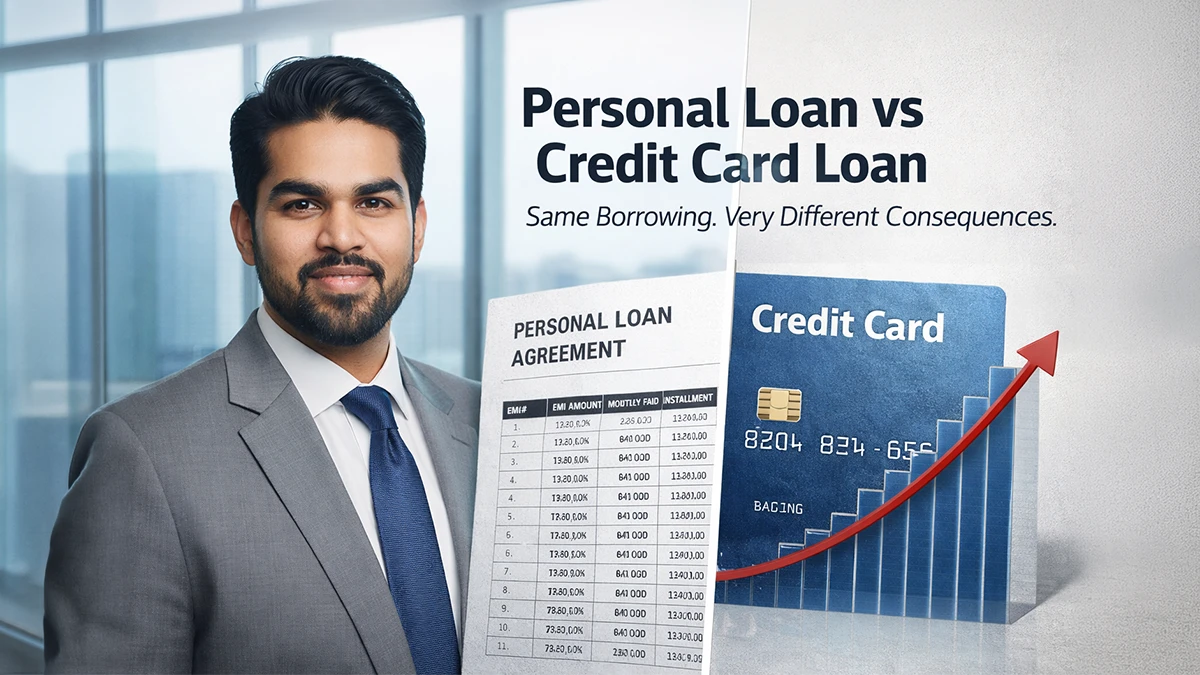
- Personal Loan vs Credit Card Loan: What You're Really Choosing
- Understanding the Structure Before the Sales Pitch
- Key Differences Between Personal Loan and Credit Card Loan
- Interest Rates: The Part People Pretend to Understand
- Repayment Behavior and Credit Score Impact
- Processing Speed vs Total Cost
- Fees, Charges, and Hidden Friction
- When Should You Choose a Personal Loan?
- When Should You Use a Credit Card Loan?
- Eligibility and Approval Dynamics
- Fixed vs Revolving Loan: Behavioral Economics
- Cost of Borrowing Comparison: US Snapshot
- So, Which Is Better?
- In the Last
Personal loan vs credit card loan is where people think they’re comparing two simple borrowing options, but what they’re actually doing is choosing between discipline and temptation, structure and flexibility, clarity and chaos.
And most of them don’t even realize it. I’ve watched this debate play out in boardrooms in New York and tea stalls in Ahmedabad, and every single time someone says, “It’s just a small loan,” I already know how the story ends.
Not pretty.
Before we dive into the deep end, it’s worth looking at situations where you might need a smaller, more accessible amount of cash.
For instance, if you’re in a pinch and don’t have traditional proof of income, understanding how to secure a 10000 loan without salary slip can be a practical first step in your borrowing journey.
As noted by the Consumer Financial Protection Bureau (CFPB), understanding the fundamental differences between loan types is crucial before you commit.
Personal Loan vs Credit Card Loan: What You’re Really Choosing
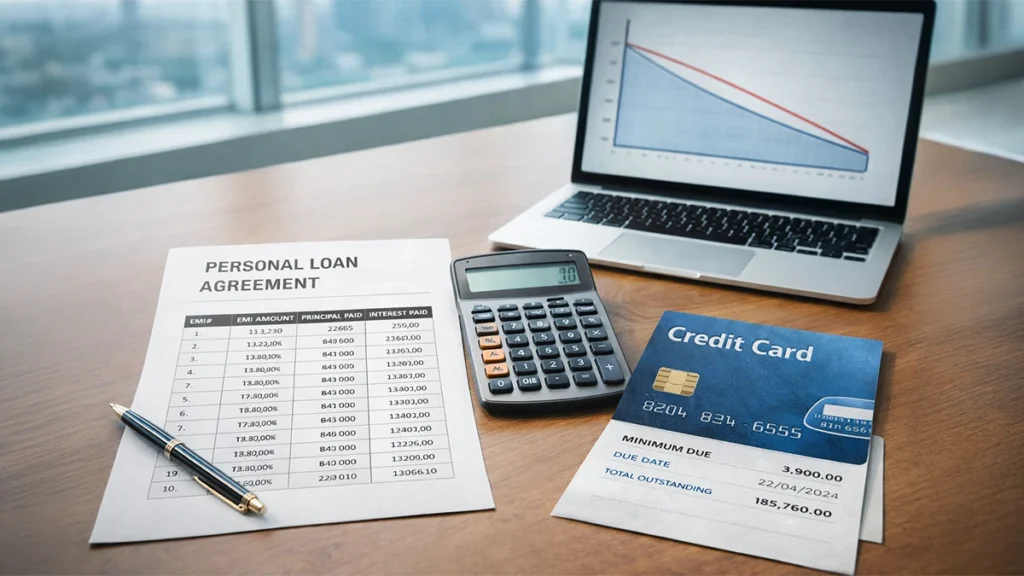
When you strip away the marketing, the cashback banners, the “instant approval” push notifications, the personal loan vs credit card loan decision comes down to one thing fixed repayment versus revolving credit, and whether you want a clean amortization schedule or a moving target that keeps adjusting under your feet.
That’s it.
A personal loan gives you a lump sum principal amount, a fixed interest rate or APR, a defined loan tenure, and a clear EMI that doesn’t change unless you default.
It’s an unsecured loan, yes, but it behaves predictably.
Credit card loan? Different animal.
It sits inside your credit limit. It plays with revolving credit. It tempts you with minimum due. It affects your utilization ratio every single month.
And that utilization ratio?
Lenders watch it closely.
In the personal loan vs credit card loan comparison, this structural difference matters more than the advertised interest rate. Most borrowers don’t get that.
Understanding the Structure Before the Sales Pitch
Let me clarify something.
In 2022, Rajesh from Pune converted ₹2 lakh into a credit card EMI through HDFC Bank because it was “instant” and required no extra documentation.
The monthly rate was 2.75%. He didn’t calculate the annual percentage rate. He didn’t ask, “What’s the total repayment?”
He just clicked accept.
That 2.75% per month translated to roughly 33% annually. His credit utilization crossed 70%. His credit score dipped. When he later applied for a home loan, underwriting flagged him as higher lender risk.
That’s how personal loan vs credit card loan decisions quietly snowball.
Now contrast that with Melissa in Chicago in 2024. She had $18,000 in revolving credit card debt at 26% APR. She refinanced into a personal loan at 11.2% APR with a fixed 36-month repayment schedule.
Her monthly installment dropped.
Her utilization improved.
Her credit score stabilized.
Same debt. Different structure.
Key Differences Between Personal Loan and Credit Card Loan
Here’s a table that cuts through the noise.
Cost of Borrowing Comparison
| Feature | Personal Loan | Credit Card Loan |
|---|---|---|
| Type | Installment (Fixed) | Revolving |
| Interest Rate | Usually lower & fixed | Higher, often variable |
| Tenure | 12–60 months | 3–48 months |
| EMI | Fixed | Can convert to EMI |
| Credit Utilization Impact | Low | High |
| Minimum Due Trap | No | Yes |
In the difference between personal loan and credit card loan, that “minimum due trap” line is deadly.
I’ve seen CFOs in Mumbai and startup founders in Austin pay minimum due for 14 months straight. Principal barely moved. Interest compounded. Late payment penalty triggered once. Credit bureau update hit.
And then they wondered why their next loan was expensive.
Behavior leaves footprints.
Interest Rates: The Part People Pretend to Understand

Let’s talk numbers without the fluff.
When someone asks, “Which loan has lower interest rate?” in the personal loan vs credit card loan debate, the answer is usually personal loan.
Usually.
In India, personal loan interest rates often range between 10%–18% depending on credit score and debt-to-income ratio. Credit card EMI conversions can quietly cost 24%–36% annually once you translate monthly rates into APR.
In the US, personal loans might sit between 8%–15% for good credit borrowers. Credit cards? 20%–30% APR is common, as per data from the Federal Reserve (Federal Reserve).
Here’s a clean example.
India Example — ₹5,00,000 Borrowing
| Loan Type | Rate | Tenure | EMI | Total Interest |
|---|---|---|---|---|
| Personal Loan | 12% p.a. | 36 months | ₹16,607 | ₹97,852 |
| Credit Card EMI | 30% p.a. | 36 months | ₹21,098 | ₹2,59,528 |
That’s over ₹1.6 lakh difference.
Not pocket change.
In the personal loan vs credit card EMI debate, this is where logic should win. But convenience often wins instead.
Repayment Behavior and Credit Score Impact
Here’s what most blog posts won’t tell you.
In personal loan vs credit card loan borrowing, credit score impact is not symmetrical.
A personal loan adds installment credit to your credit mix. If you pay EMIs on time, your payment history strengthens. Utilization isn’t distorted.
Credit card loan?
High balance relative to credit limit increases utilization ratio. Cross 30%–40%, and scoring models start reacting. Miss a due date, and late payment penalty plus bureau reporting hits immediately.
It’s not dramatic.
It’s mathematical.
In the unsecured loan comparison, revolving debt is more sensitive to behavior than fixed repayment loans. This is particularly important to remember if your credit history isn’t perfect.
If you are also considering other major purchases, like a vehicle, you might find our guide on a car loan for bad credit helpful for understanding how different lenders assess risk.
Processing Speed vs Total Cost
People say, “Credit card loan is instant.”
True.
You open your mobile banking app. You see “Convert to EMI?” You click. Done. No fresh credit check sometimes. No extra underwriting.
But here’s reality in 2025.
Personal loans aren’t slow anymore. In India, fintech lenders disburse within 24–48 hours. In the US, online lenders deposit funds in a day or two after credit check and underwriting.
So in personal loan vs credit card loan, speed is not the 1998-era difference people imagine.
Cost is.
Fees, Charges, and Hidden Friction
Now we get to the boring part that actually matters.
Personal loan charges may include processing fee, maybe 1–3%, possibly prepayment charges. Some lenders include foreclosure charges if you close early.
Credit card loan charges can include cash advance fee, foreign transaction fee, late payment fee, annual fee, and higher APR without grace period.
Stack them.
Compare total repayment.
When someone asks, “Is credit card loan cheaper than personal loan?” the only intelligent response is, “Show me the APR and total cost.”
Monthly rate means nothing without context.
When Should You Choose a Personal Loan?
Let’s make this practical.
In the personal loan vs credit card loan which is better discussion, personal loan wins when:
- You need a large amount
- You want predictable EMI
- You’re consolidating high-interest debt
- You care about protecting credit utilization
- You prefer structured repayment
Personal loan for large expenses is logical.
Home renovation. Medical emergency. Wedding. Business equipment.
Structured borrowing.
When Should You Use a Credit Card Loan?
Now I’m not blind.
Credit card loan for emergencies can make sense in very short-term scenarios.
If you need ₹50,000 or $1,000 for a genuine short-term gap and you will clear it within 2–3 months, it might work. Especially if there’s a 0% promotional APR window.
But here’s the catch.
You must be disciplined.
Not “I think so.”
Actually disciplined.
Because in the personal loan vs credit card debt equation, short term vs long term credit matters. Drag revolving debt beyond six months at high APR and it becomes expensive fast.
Eligibility and Approval Dynamics
Another overlooked angle in personal loan vs credit card loan eligibility.
Personal loan eligibility depends on income proof, debt-to-income ratio, credit score, sometimes employment stability. There may be a hard inquiry during credit check.
Credit card loan eligibility is usually pre-approved based on your existing credit limit and repayment history. Minimal documentation requirement.
So yes, credit card installment loan vs personal loan is easier from an access perspective.
But easy access doesn’t equal smart borrowing.
Fixed vs Revolving Loan: Behavioral Economics

Let’s zoom out.
In personal loan vs credit card loan comparison, the psychological difference is massive.
Fixed repayment forces discipline. You know the EMI. You know the due date. You set automatic payment. You move on.
Revolving credit feels flexible. You can pay minimum due. You can skip full repayment. You can carry balance.
That flexibility is seductive.
And dangerous.
I’ve seen borrowers in both India and the US underestimate how quickly revolving balances compound. They assume income will rise next quarter. It doesn’t always.
They assume expenses will shrink. They don’t.
Then delinquency appears.
Then arrears.
Then stress.
Cost of Borrowing Comparison: US Snapshot
| Loan Type | APR | Term | Monthly Installment | Total Interest |
|---|---|---|---|---|
| Personal Loan | 11% | 36 months | ~$327 | ~$1,772 |
| Credit Card | 25% | 36 months | ~$398 | ~$4,328 |
In personal loan vs credit card loan, that $2,500+ difference isn’t theoretical. It’s cash leaving your pocket.
Every month.
So, Which Is Better?
Wrong framing.
The real question in the personal loan vs credit card loan debate is this: are you borrowing with a plan, or are you borrowing for convenience?
If you’re casual about money, choose fixed repayment.
If you’re disciplined and genuinely short-term, credit card loan might be fine.
But I’ll say this plainly.
For meaningful borrowing amounts, personal loan is usually the safer structure.
Because it limits behavioral mistakes.
And most financial damage doesn’t come from bad math.
It comes from bad habits.
Before you make any decision, it’s wise to consider how different types of financial products fit into your overall budget. For example, just as you would compare loan structures, you should also compare costs for other necessities, like understanding a travel insurance comparison before a big trip.
You can argue with that if you want.
But the credit report won’t.
(This is an estimate based on your provided profile)
Is it better to take a loan or credit card?
A personal loan is usually better for large expenses because it offers fixed EMIs and lower interest rates. Credit cards are better for short-term spending only if you can repay the full balance within one billing cycle. Carrying a credit card balance long-term can become much more expensive than a structured personal loan.
Is it better to have a personal loan or a credit card balance?
A personal loan is generally safer than carrying a credit card balance because it has a fixed repayment schedule and lower interest rates. Credit card balances often attract high interest if not paid in full, which can quickly increase total repayment. Loans provide predictable payments and faster debt reduction.
Is it harder to get a personal loan or a credit card?
Credit cards are usually easier to get because approval limits are lower and risk for lenders is spread across revolving credit. Personal loans may require stronger income proof and credit stability. However, approval ultimately depends on your credit score, income, and existing debt levels.
What happens if I use 90% of my credit card?
Using 90% of your credit limit raises your credit utilization ratio significantly. This can lower your credit score because lenders see high utilization as financial risk. Experts recommend keeping utilization below 30% to maintain a healthy credit profile and improve loan approval chances.
What is the 2/3/4 rule for credit cards?
The 2‑3‑4 rule suggests applying for no more than two credit cards in 30 days, three in 12 months, and four in 24 months. It helps reduce hard inquiries and protect your credit score. Some banks follow similar internal policies to limit excessive credit-seeking behavior.
In the Last
When choosing between a personal loan and a credit card, the right option depends on your financial discipline and the size of the expense.
If you can repay quickly, a credit card may work. But for larger amounts or structured repayment, a personal loan usually offers more stability and lower interest risk.
As I always say, smart borrowing is not about access to credit, it’s about managing it wisely. Think long term, protect your credit score, and choose the option that keeps your finances under control.