- Term Insurance vs Life Insurance 2026 — which one is right for me?
- Understanding the Basics of Financial Protection
- Head-to-Head Comparison: Term vs Traditional Life Insurance
- Term Insurance vs Life Insurance
- Detailed Comparison Explained (Real Talk)
- Why You Need Insurance More Than Ever in 2026
- How Much Life Cover Do You Really Need?
- A Deep Dive into the Pros and Cons: Choosing Your Shield
- Critical Illness and Riders in 2026
- Step-by-Step Guide to Buying Insurance Online
- Common Insurance Myths Debunked
- Frequently Asked Questions (FAQs)
- Is it possible to hold both Term and Life Insurance simultaneously?
- Will I get my premiums back in a Term Insurance plan?
- What is the ideal age to secure an insurance policy?
- Which option provides better security for my family?
- Can I increase my coverage amount at a later stage?
- Is a medical examination mandatory for all applicants?
- How safe is it to purchase insurance policies online?
- Do homemakers really need their own insurance cover?
- Conclusion: Final Advice from Deeksha
Last Updated: January 15, 2026
If you are confused about Term Insurance vs Life Insurance 2026, you are not alone. A few years ago, I met a family who thought their future was completely sorted with a decent income and an old policy. But when life happened—medical bills rose and inflation hit—they realized their coverage was way too small for the world of 2026.
I’m Deeksha, your insurance expert at Finance Help Check. I see this story every single day. In 2026, financial security is no longer optional; it is basic survival planning. With rising education costs and expensive healthcare, choosing the right protection is critical.
Still, most people are stuck on the same big question: which one actually works for a modern family? Is it the pure protection of term plans or the savings element of traditional life insurance?
This guide is written to clear that confusion. No complicated jargon. No sales talk. Just honest advice to help you decide which path secures your family’s future in 2026.
Term Insurance vs Life Insurance 2026 — which one is right for me?
Some want pure protection.
Some want safety plus savings.
Many don’t even know the difference.
This guide is written to clear that confusion. No complicated words. No sales talk. Just clear thinking, real examples, and honest advice. By the end, you will know exactly what fits your family and your future.
Understanding the Basics of Financial Protection
Insurance is not about profit.
It is about peace of mind.
Before comparing plans, let’s understand the two main types clearly.
What is Term Insurance? (The Pure Shield)
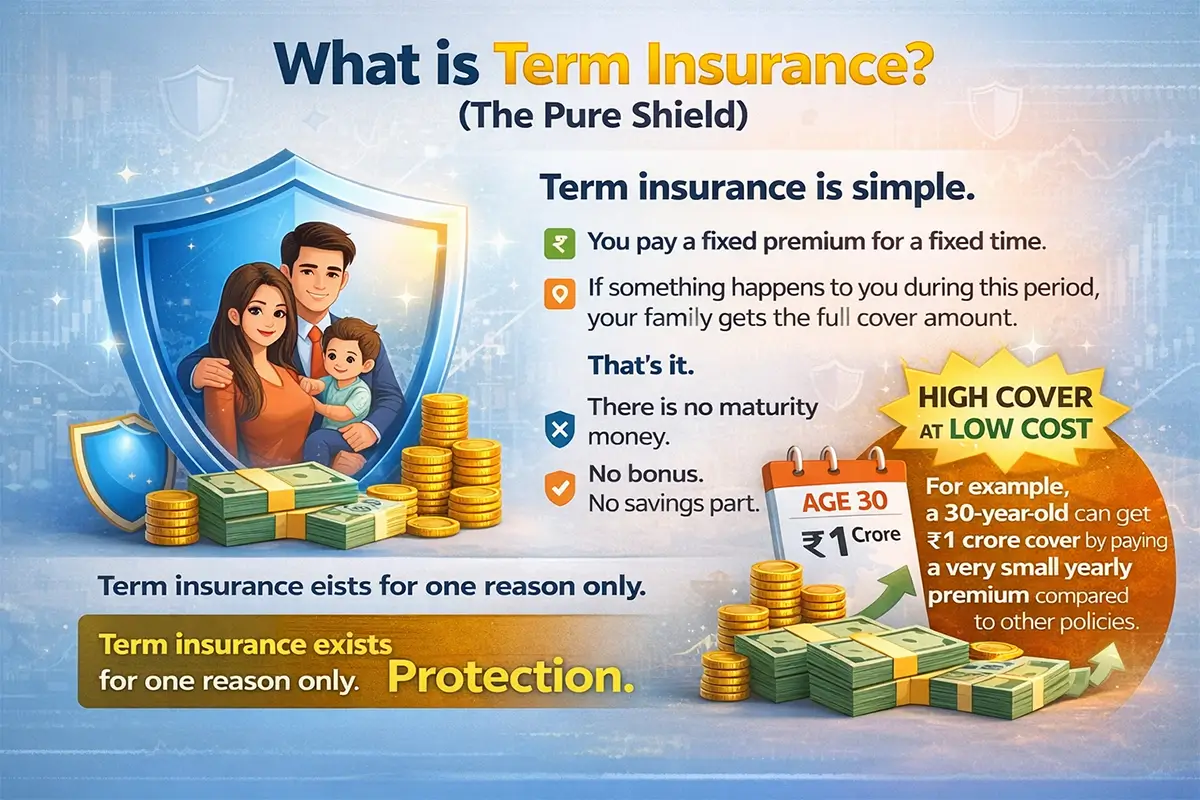
Term insurance is simple.
You pay a fixed premium for a fixed time.
If something happens to you during this period, your family gets the full cover amount.
That’s it.
There is no maturity money.
No bonus.
No savings part.
The biggest advantage is high cover at low cost.
For example, a 30-year-old can get ₹1 crore cover by paying a very small yearly premium compared to other policies. That money can replace income, clear loans, and keep the family stable.
Term insurance exists for one reason only.
Protection.
What is Life Insurance (Endowment / Whole Life)? (The Savings Shield)
Traditional life insurance works differently.
Here, your premium has two parts.
One part gives life cover.
The other part goes into savings.
If you survive the policy term, you get money back. This is why people call it “money back” or “guaranteed return” insurance.
Many families like this because:
- They see it as forced saving
- They like guaranteed returns
- They feel safer knowing money will come back
But the cost is higher. And the life cover is usually much lower compared to term plans.
Head-to-Head Comparison: Term vs Traditional Life Insurance
Term Insurance vs Life Insurance
A comprehensive comparison to help you choose the right insurance policy for your needs
Features & Benefits |
Term Insurance
Pure Protection |
Life Insurance
Protection + Savings |
|---|---|---|
Premium Cost
Annual premium for ₹1 Cr coverage | ₹8,000 – ₹12,000 Very Affordable Low cost, high coverage | ₹50,000 – ₹1,00,000 Expensive Higher cost due to savings component |
Policy Tenure
Duration of coverage | 10-40 Years Flexible Choose based on financial responsibilities | 10-30 Years Standard Usually until retirement age |
Maturity Benefit
Return at policy maturity | No Return Zero Payout Pure risk cover only | Sum Assured + Bonus High Return Get back premiums with returns |
Death Benefit
Payout to nominee on death | Sum Assured High Coverage Full sum assured paid to nominee | Sum Assured Guaranteed Sum assured paid to nominee |
Investment Component
Savings or investment element | None Pure Insurance No savings or investment | Yes With Investment Combines insurance with savings |
Best For
Ideal candidate profile | Young Earners Young Family High coverage at low cost | Long-term Savers Conservative Investors Want insurance + savings |
Choose Term Insurance If:
You want maximum life cover at minimum cost and don’t need maturity benefits.
Choose Life Insurance If:
You want both insurance protection and a savings/investment component.
Detailed Comparison Explained (Real Talk)
Premium Difference
Term insurance is cheap because it only covers risk. Life insurance costs more because part of your money is locked for savings.
Life Cover Amount
With term insurance, you can easily afford large covers. With traditional plans, high cover becomes expensive very fast.
Maturity Benefit Reality
Life insurance returns money, yes. But returns are usually modest when compared to long-term investments. People often don’t calculate this properly.
Flexibility
Term plans are clean and clear. Life plans are rigid. Once locked, changes are difficult.
Who Wins Here?
If protection is your main goal, term insurance wins.
If the emotional comfort of guaranteed money matters more, life insurance feels safer.
Why You Need Insurance More Than Ever in 2026
The insurance world has changed.
Private insurers are growing fast. Digital policies are now common. Claim processes are quicker and paperless.
Most insurers now offer:
- Online buying
- Video medical checks
- Faster claim settlements
Regulation is also stronger under the Insurance Regulatory and Development Authority of India (IRDAI), which protects policyholders better than before.
Insurance and emergency planning go hand in hand.
How Much Life Cover Do You Really Need?
Buying insurance without calculation is a mistake.
Let’s keep it simple.
The Income Replacement Method
A basic rule used in 2026 is:
Life cover = 10x to 15x of your annual income
If you earn ₹10 lakh per year, your cover should be between ₹1 crore to ₹1.5 crore.
This ensures your family can manage daily expenses even if income stops.
Considering Your Debt & Loans
Income alone is not enough.
Add:
- Home loan
- Personal loan
- Education loan
- Credit card dues
Your life cover should be enough to clear all debts and still support your family.
A Deep Dive into the Pros and Cons: Choosing Your Shield
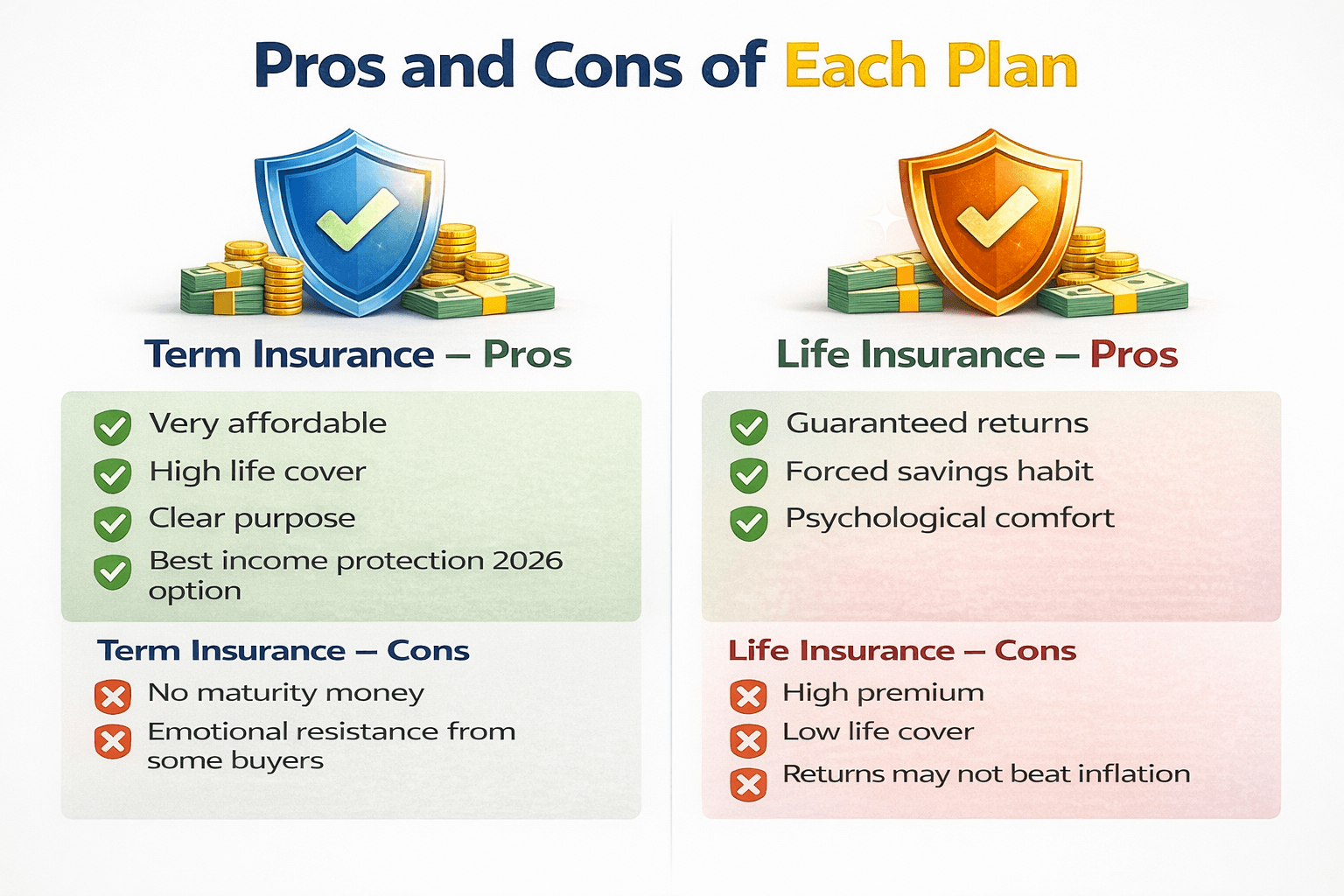
While the image above provides a quick visual summary, it is essential to understand the “why” behind these points. In 2026, where economic shifts and inflation are constant, these details will help you make a future-proof decision.
1. The Power of Term Insurance (Why It’s Essential)
- Affordability vs. Wealth Protection: Term insurance is cost-effective because you are paying strictly for the “Risk”. In 2026, with rising lifestyle diseases, a high cover (e.g., ₹1 Crore+) ensures your family’s lifestyle remains stable without a massive premium burden.
- Pure Income Replacement: Unlike other plans, every rupee is focused on replacing your monthly salary. It is the cleanest financial product to ensure your family can clear debts, such as the ones discussed in our low CIBIL loan 2026 guide.
- The “No Maturity” Hurdle: Many buyers feel emotional resistance because there is no “money back”. However, think of it like car or health insurance—you pay for protection, not for a profit.
2. The Security of Traditional Life Insurance (The Emotional Edge)
- Guaranteed Maturity for Goals: Life insurance (Endowment) plans are helpful for those who struggle with saving discipline. If you have a long-term goal for 2040, these plans ensure a fixed amount reaches you regardless of market volatility.
- The Psychological “Win”: In many households, there is a preference for seeing premiums as “saved” rather than “spent”. This psychological comfort helps many people stay invested for 15–20 years.
- The Inflation Trap: The biggest drawback is that while you get money back, its purchasing power in the 2040s might be much lower due to inflation. These plans are best for those prioritizing 100% safety over high growth.
Critical Illness and Riders in 2026
Riders are add-ons. They increase protection.
Popular riders include:
- Accidental Death Benefit – extra payout for accidents
- Critical Illness Rider – covers cancer, heart attack, major diseases
- Waiver of Premium – future premiums waived if illness strikes
These riders are more relevant today because healthcare costs are unpredictable.
Step-by-Step Guide to Buying Insurance Online
Step 1: Assess Your Needs
Know why you are buying insurance. Protection or savings.
Step 2: Compare Quotes
Never buy blindly. Compare premiums and features.
Step 3: Medical Checkups
Be honest. Hiding health issues leads to claim rejection.
Step 4: Nomination
Always update nominees. This avoids family disputes later.
Common Insurance Myths Debunked
Myth: Insurance is an investment
Truth: Insurance is protection. Investments grow money. Both have different jobs.
Myth: I am young, I don’t need insurance
Truth: Younger age means lower premium. Waiting costs more.
Myth: Office insurance is enough
Truth: Group cover ends when the job ends. Personal cover stays with you.
Frequently Asked Questions (FAQs)
Is it possible to hold both Term and Life Insurance simultaneously?
Absolutely. In fact, many experts suggest a combined approach when comparing Term Insurance vs Life Insurance 2026 strategies. You can use a Term plan for high-value protection during your working years and a Life policy for long-term wealth or legacy planning.
Will I get my premiums back in a Term Insurance plan?
Standard Term Insurance is a pure protection tool, meaning premiums aren’t returned. However, the 2026 market offers TROP (Return of Premium) plans for those who find the “no-return” aspect a drawback in the Term Insurance vs Life Insurance 2026 debate.
What is the ideal age to secure an insurance policy?
The “Golden Rule” is to buy as early as possible. Whether you are looking at Term Insurance vs Life Insurance 2026 options, locking in a policy in your 20s ensures lower premiums and guaranteed coverage before health issues arise.
Which option provides better security for my family?
For pure financial survival, Term Insurance is superior. It offers a massive sum assured for a very low cost, which is a key highlight when evaluating Term Insurance vs Life Insurance 2026 for primary breadwinners.
Can I increase my coverage amount at a later stage?
Yes, many modern 2026 products offer “Life Stage Increments.” This allows you to boost your cover during milestones like marriage or parenthood, making the choice of Term Insurance vs Life Insurance 2026 more flexible for growing families.
Is a medical examination mandatory for all applicants?
While some digital plans offer “no-medical” versions, most insurers require a health checkup for high coverage. This is a standard step regardless of your preference in the Term Insurance vs Life Insurance 2026 comparison.
How safe is it to purchase insurance policies online?
Purchasing online is 100% secure. By 2026, digital platforms have made it easier to compare Term Insurance vs Life Insurance 2026 directly from insurers, saving you up to 15% on commissions.
Do homemakers really need their own insurance cover?
Definitely. The economic value a homemaker adds is immense. Choosing the right plan between Term Insurance vs Life Insurance 2026 for a homemaker ensures household stability even during difficult times.
Conclusion: Final Advice from Deeksha
Deciding on Term Insurance vs Life Insurance 2026 isn’t about following a trend; it’s about absolute mental peace. Ask yourself: If you weren’t here tomorrow, would your family’s dreams perish with you? If that thought scares you, the time to act is now.
While Term Insurance replaces your income, Life Insurance builds a foundation for future milestones. Security delayed is security denied—protect your family’s smile today.