
- General Insurance Meaning in Simple Words
- How Does General Insurance Work?
- Types of General Insurance in India
- Benefits of General Insurance
- 7 Principles of General Insurance
- General Insurance vs Life Insurance
- Real-Life Examples of General Insurance
- How to Choose the Right General Insurance Policy
- General Insurance for Different Life Stages
- Top General Insurance Companies in India (2026)
- Common Myths About General Insurance
- Tax Benefits of General Insurance in India
- Frequently Asked Questions
- What is general insurance in simple words?
- What are the 4 main types of general insurance?
- What are the 7 principles of general insurance?
- What is the difference between general and life insurance?
- Is health insurance a type of general insurance?
- Is general insurance mandatory in India?
- How long does a general insurance policy last?
- Can I buy multiple general insurance policies?
- How to Pick Your First Policy Today
- Bottom Line
Imagine your car gets flooded overnight. Or you’re rushed to a hospital far from home.
These things happen without warning. And without the right cover, they can wipe out savings you took years to build. That’s exactly what is general insurance designed to prevent: financial protection against unexpected losses to your health, property, and assets.
What is General Insurance? (Quick Definition)
What is general insurance at its core? It is a type of insurance that protects your assets and health against unforeseen losses. It covers everything except death. These policies are short-term, usually 1 year, and work on the principle of indemnity: they restore your financial position to what it was before the loss.
Examples include: Health Insurance, Motor Insurance, Home Insurance, Travel Insurance, and more.

This guide covers types, benefits, the 7 principles, how to file a claim, tax savings, and how to choose the right policy.
General Insurance Meaning in Simple Words
When people hear “insurance,” most think of life cover. But what is general insurance is a separate, broader question. “General” simply means everything outside life and death coverage.
What Does ‘General’ Mean in Insurance?
Life insurance covers you. General insurance covers everything else around you: your car, your home, your health, your business, and your travel plans.
Think of it like a scoreboard that tracks everything other than your own life. Every asset, every risk, every trip gets a column.
General Insurance in India: Context
Understanding what is general insurance in India starts with scale: the market reached Rs 2.89 lakh crore in FY2023-24, growing at 16.22% year on year. The market is regulated by IRDAI (Insurance Regulatory and Development Authority of India), set up under the IRDAI Act, 1999.
Here’s a fact most people don’t know: India’s first general insurance company was Triton Insurance Company, established in 1850 in Calcutta. That’s over 170 years of non-life insurance history in India.
How Does General Insurance Work?
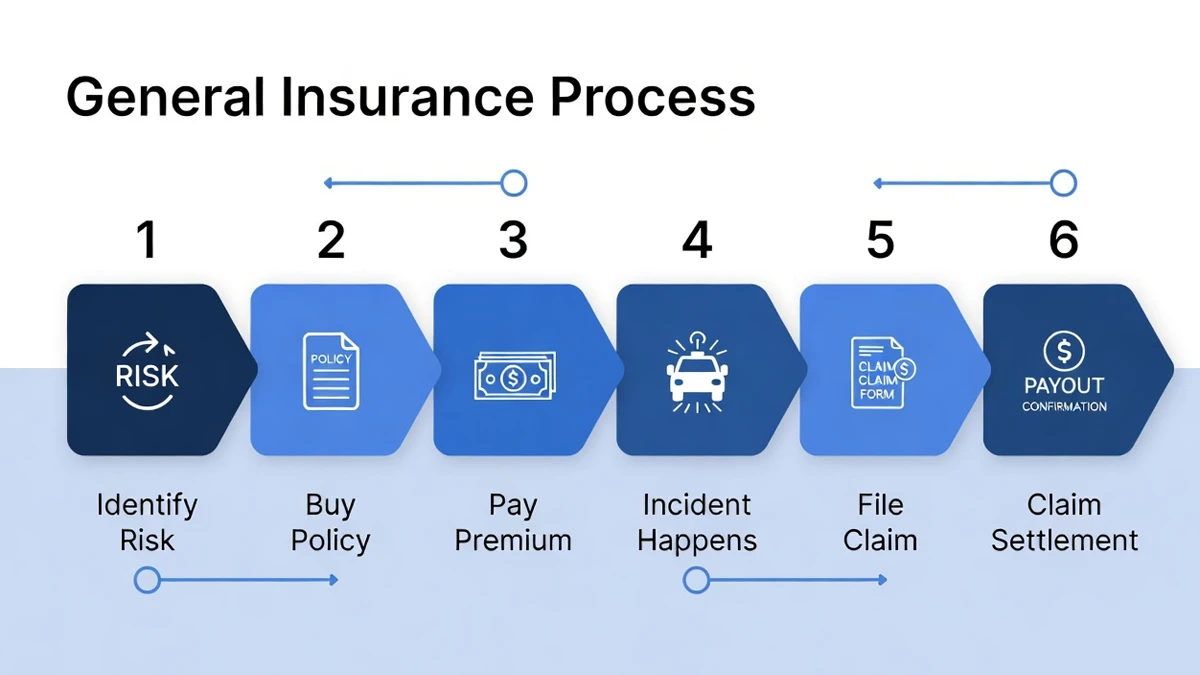
The basic mechanics are simple. You pay a small, regular amount (called a premium) to an insurer. In return, they agree to compensate you if a specific loss occurs.
The Step-by-Step Working Mechanism
Here’s how the process flows from start to claim settlement.
- Identify your risk. You decide what to protect: your car, your health, your home.
- Buy a policy and pay your premium. The insurer pools this with premiums from thousands of other policyholders.
- The insurer manages the pool. Most policyholders never claim. The pool funds those who do.
- A covered loss occurs. You inform your insurer immediately after the incident.
- File your claim with documents. The insurer sends a surveyor or investigator.
- Claim is reviewed and settled. Payment is made by cashless settlement or direct reimbursement.
The Principle of Indemnity Explained Simply
This principle is the heart of general insurance. Insurance is not a way to profit from a loss. It restores your financial position to exactly where it was before the damage.
If your car is worth Rs 8 lakh and gets damaged, the insurer pays the repair cost, not Rs 8 lakh. You get back to where you were, not ahead of it.
What is a Premium and How is it Calculated?

Your premium is the price you pay for the coverage. It’s not fixed for everyone.
Insurers look at the age of the asset, its value, your claim history, your location, and the type of coverage you want. A sports car owner pays a higher premium than someone with a small hatchback. Higher risk always means higher premium.
Types of General Insurance in India
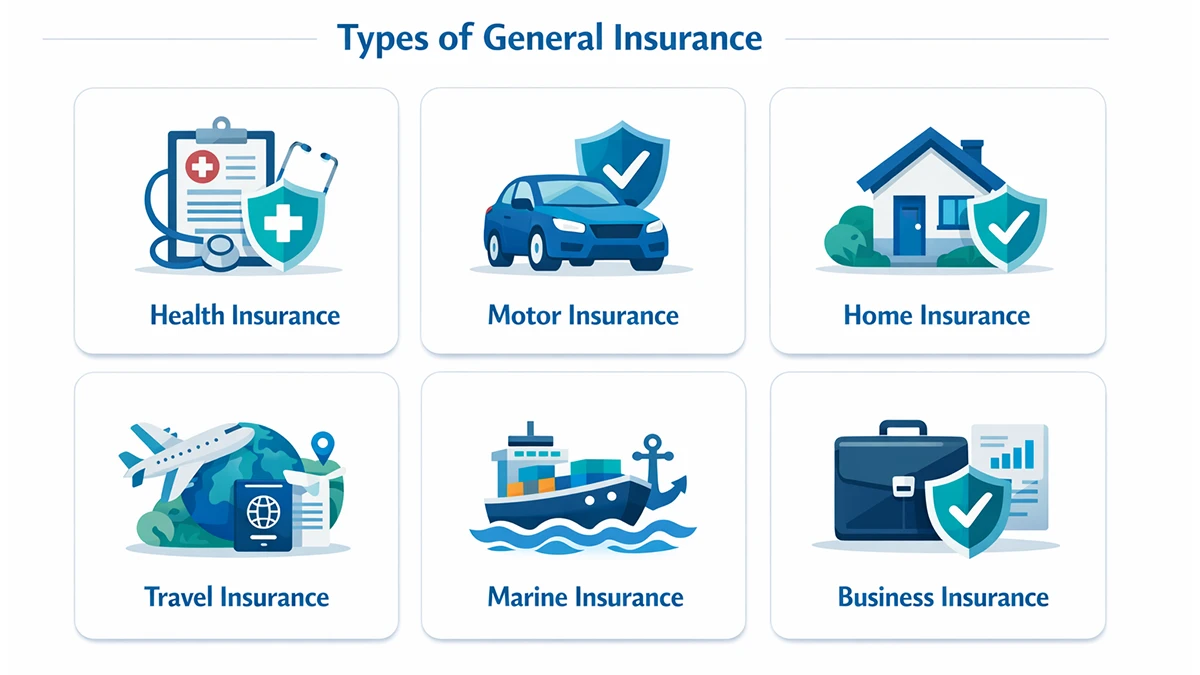
India has a wide range of general insurance products, from the basics most people know to newer options many haven’t heard of yet. Each type covers a different category of risk.
Health Insurance
Health insurance covers your medical costs: hospitalization, surgery, pre- and post-hospital expenses, and critical illness treatment.
Sub-types include individual plans, family floater plans, group health policies, and senior citizen plans.
IRDAI 2025 Update: From September 22, 2025, health insurance premiums attract 0% GST. That’s a direct cost saving for every policyholder.
Under Section 80D of the Income Tax Act, you can claim up to Rs 25,000 per year on health insurance premiums. If your parents are senior citizens, add Rs 50,000 more, making the combined maximum Rs 1,00,000. See how Section 80D deductions work in detail for a full breakdown.
Motor Insurance
Motor insurance is not optional for most vehicle owners. Under the Motor Vehicles Act, 1988, third-party motor insurance is legally mandatory for all vehicles on Indian roads.
Three types are available: third-party only (covers damage to others), own damage (covers your vehicle), and comprehensive (covers both).
2025 Update: Pay-As-You-Drive (PAYD) policies are now available. You pay based on how much you actually drive, not a flat annual premium.
Real example: Rahul’s car was dented in an accident. Repair cost: Rs 45,000. His comprehensive policy covered 90% after the deductible. He paid just Rs 4,500.
Home Insurance
Home insurance protects your house structure and contents against fire, floods, earthquakes, cyclones, and theft.
Here’s a number worth knowing: only about 1% of homes in India are insured. That means 99 out of 100 Indian homeowners are fully exposed to one flood or one fire wiping them out financially.
Travel Insurance
Travel insurance covers trip cancellations, baggage loss, passport theft, and medical emergencies while you’re away from home.
Most policies now cover COVID-19 related medical emergencies abroad. Skipping travel insurance to save Rs 800 is one of the most expensive decisions a traveller can make.
Marine Insurance
Marine insurance covers goods while they’re being transported: by sea, air, road, or rail.
This is primarily for businesses. Exporters, importers, and logistics companies use it to protect cargo in transit. Two main types: marine cargo (protects goods) and marine hull (protects the vessel).
Commercial and Business Insurance
Businesses face risks that personal policies don’t cover. Commercial insurance includes fire insurance, liability insurance, cyber insurance, and workmen’s compensation cover.
Growing sub-types include Directors and Officers (D&O) liability, product liability, and trade credit insurance. India’s SME segment is adopting these faster than ever.
Niche and Emerging Insurance Types
Most people aren’t aware these even exist. And some of them are growing fast.
- Pet insurance covers veterinary costs for your dog or cat. Growing fast among urban pet owners.
- Crop insurance under PM Fasal Bima Yojana protects farmers against crop failure from natural disasters.
- Mobile and gadget insurance covers accidental damage and theft of your phone or laptop.
- Bicycle insurance covers urban cyclists against theft and accidental damage.
- Micro/bite-sized insurance is the newest trend. Pay per use, pay per trip, pay per day. InsurTech companies are driving this in 2024-25.
Benefits of General Insurance
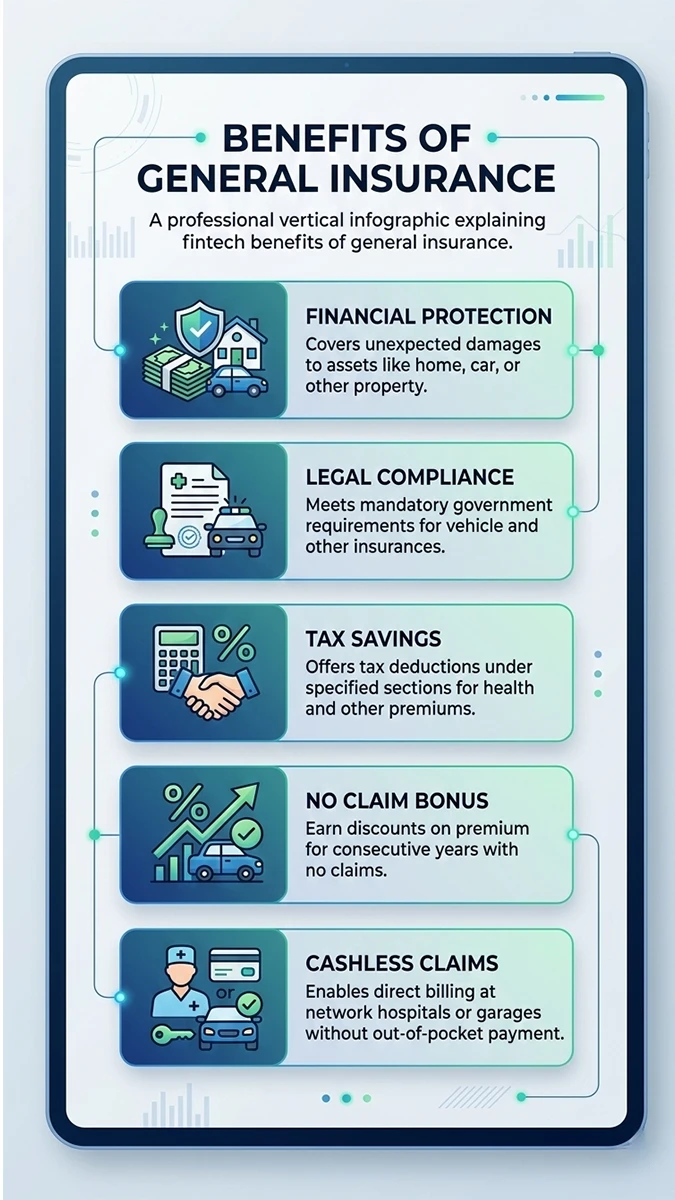
General insurance does more than just pay claims. Done right, it changes how much financial risk you carry every single day.
Financial Protection from Unexpected Losses
A single hospitalization in a private hospital can cost Rs 2 to 10 lakh. Without insurance, that bill comes entirely from your savings. With it, the insurer absorbs most of the hit.
Legal Compliance
Motor insurance is legally required. Driving without third-party insurance attracts a fine of Rs 2,000 for the first offence and Rs 4,000 for subsequent offences under the Motor Vehicles Act.
Tax Savings
Section 80D gives you real money back. At the 30% tax bracket, a Rs 25,000 health insurance premium saves you Rs 7,500 in tax every year.
No Claim Bonus
If you don’t file any claims during a policy year, your insurer rewards you with a discount on the next renewal premium. For motor insurance, NCB can go up to 50% after five claim-free years.
Cashless Claim Settlement
At network hospitals and garages, the insurer settles the bill directly. You walk in, get treated or repaired, and walk out. No upfront payment, no reimbursement wait.
Customisable Coverage Through Riders
Most policies let you add riders: zero depreciation cover for motor, OPD cover for health, accidental death benefit. You build the coverage you actually need.
7 Principles of General Insurance
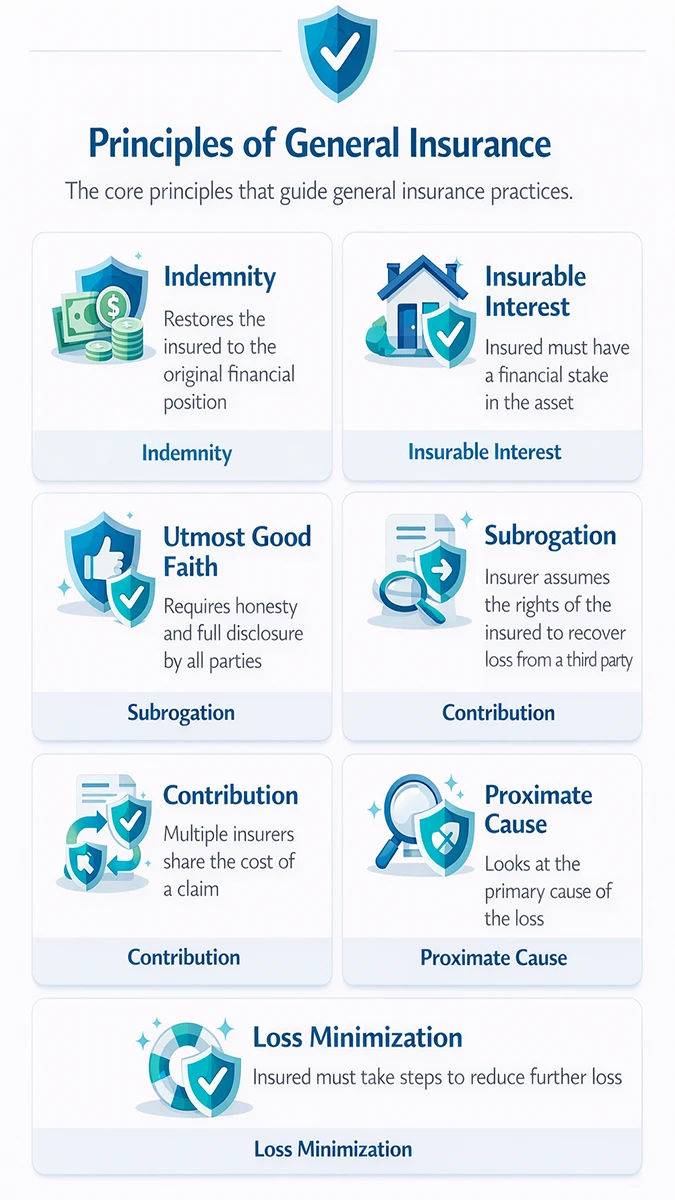
Every general insurance contract is built on seven foundational principles. These aren’t just academic rules. They shape exactly how your claim gets processed.
Understanding these will help you avoid claim rejections that most policyholders never see coming.
| Principle | What It Means | Simple Example |
|---|---|---|
| 1. Indemnity | Compensate actual loss only, no profit | Car repair cost paid, not full car value |
| 2. Insurable Interest | You must have a financial stake in what you insure | You can’t insure your neighbor’s car |
| 3. Utmost Good Faith | Full honest disclosure when buying | Declare pre-existing illness in health policy |
| 4. Subrogation | After paying you, insurer can sue the third party | Insurer recovers cost from driver who hit you |
| 5. Contribution | Two policies covering same risk share the claim | Two health policies split one hospital bill |
| 6. Proximate Cause | Nearest direct cause determines claim validity | Flood damage covered, gradual damp seepage is not |
| 7. Loss Minimization | You must try to limit loss even after incident | Move belongings from a flooded room immediately |
But here’s what matters most in practice: Principles 1, 3, and 6 are responsible for the majority of rejected claims in India. Non-disclosure at purchase time and disputes over the proximate cause are the two most common reasons insurers deny valid-seeming claims.
General Insurance vs Life Insurance
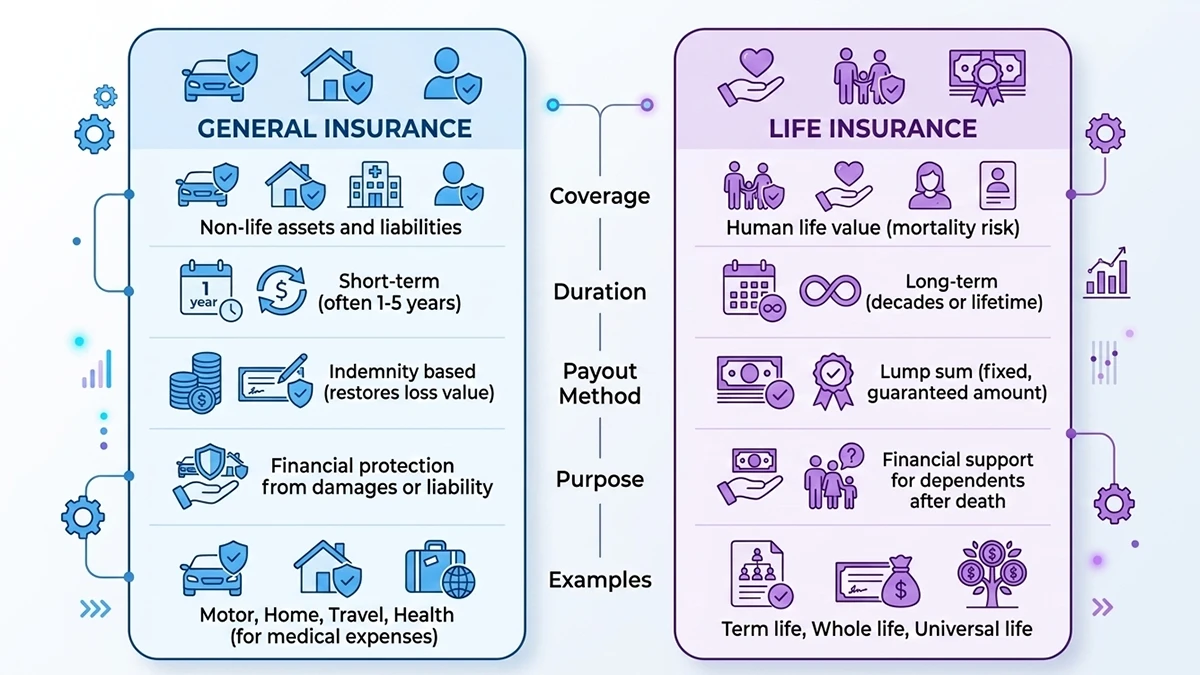
A lot of people assume general insurance is just another name for life insurance. It isn’t. They work differently, cost differently, and serve completely different purposes.
| General Insurance | Life Insurance |
|---|---|
| Covers assets, health, property (not death) | Covers human life (death or disability) |
| Typically 1 year, renewed annually | Long-term (10 to 40 years) |
| Based on indemnity (actual loss restored) | Based on sum assured (fixed payout) |
| No maturity or savings benefit | Savings or investment component available |
| Premium based on asset value and risk | Premium based on age and health |
| Multiple policies possible simultaneously | Usually one policy per person |
| Claim on occurrence of covered event | Claim on death or policy maturity |
| Examples: Health, Motor, Home, Travel | Examples: Term plan, ULIP, Endowment |
The key takeaway: you need both, for different reasons. Life insurance protects your family’s future if you’re gone. General insurance protects your present financial stability.
Real-Life Examples of General Insurance
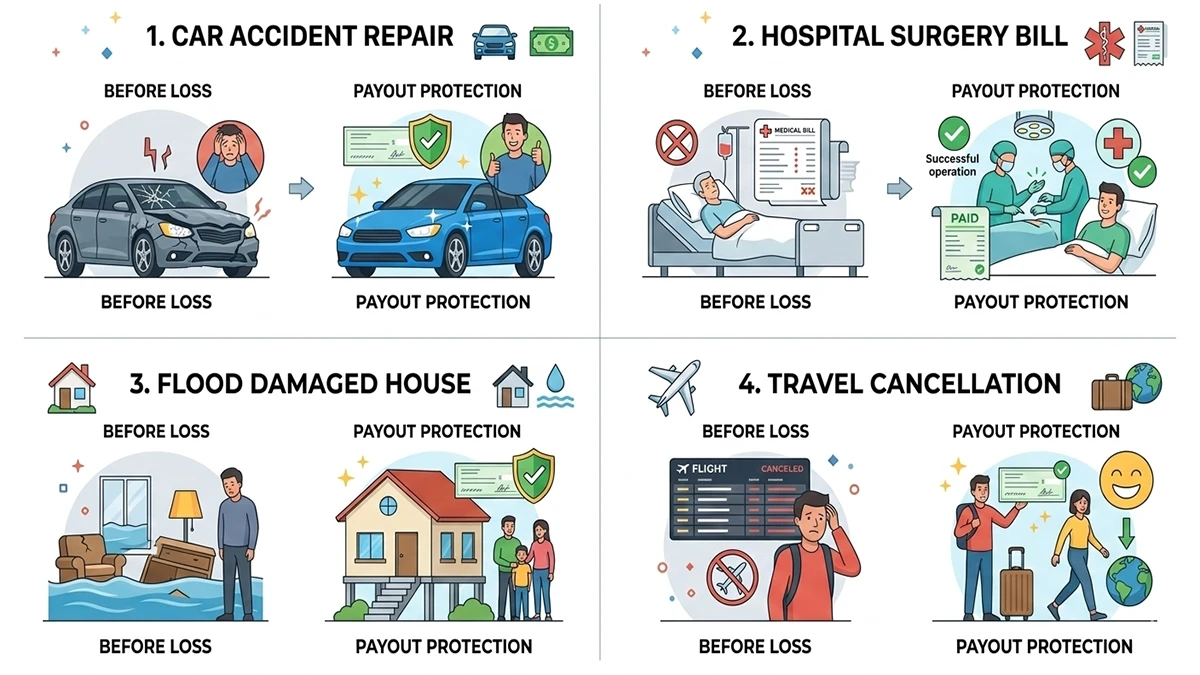
Numbers make this real. Here are four scenarios showing exactly how general insurance works in practice.
Motor Insurance: Priya’s Accident
Priya’s car was hit from behind on the Mumbai-Pune expressway. Repair cost: Rs 52,000. Her comprehensive policy covered 90% after the deductible. She paid only Rs 5,200 out of pocket.
Health Insurance: Arvind’s Surgery
Arvind was rushed to hospital in Bengaluru for appendix surgery. Total bill: Rs 1.8 lakh. His family floater health insurance covered Rs 1.65 lakh cashlessly. He paid just the deductible and a small co-pay.
Home Insurance: Sunita’s Flood Damage
Sunita’s ground floor apartment in Chennai was damaged in flash floods. Estimated loss: Rs 3.8 lakh for contents and structural repair. Her home insurance covered Rs 3.2 lakh.
Without it, she would have had to empty her emergency fund entirely.
Travel Insurance: Vikram’s Cancelled Flight
Vikram’s international flight was cancelled four hours before departure. His non-refundable hotel bookings abroad came to Rs 18,000. Travel insurance reimbursed the full amount within 10 working days.
How to File a General Insurance Claim
Filing a claim doesn’t have to be stressful. The process is fairly standard across most insurers once you know the steps.
Knowing these steps before a crisis happens is worth more than reading them after.
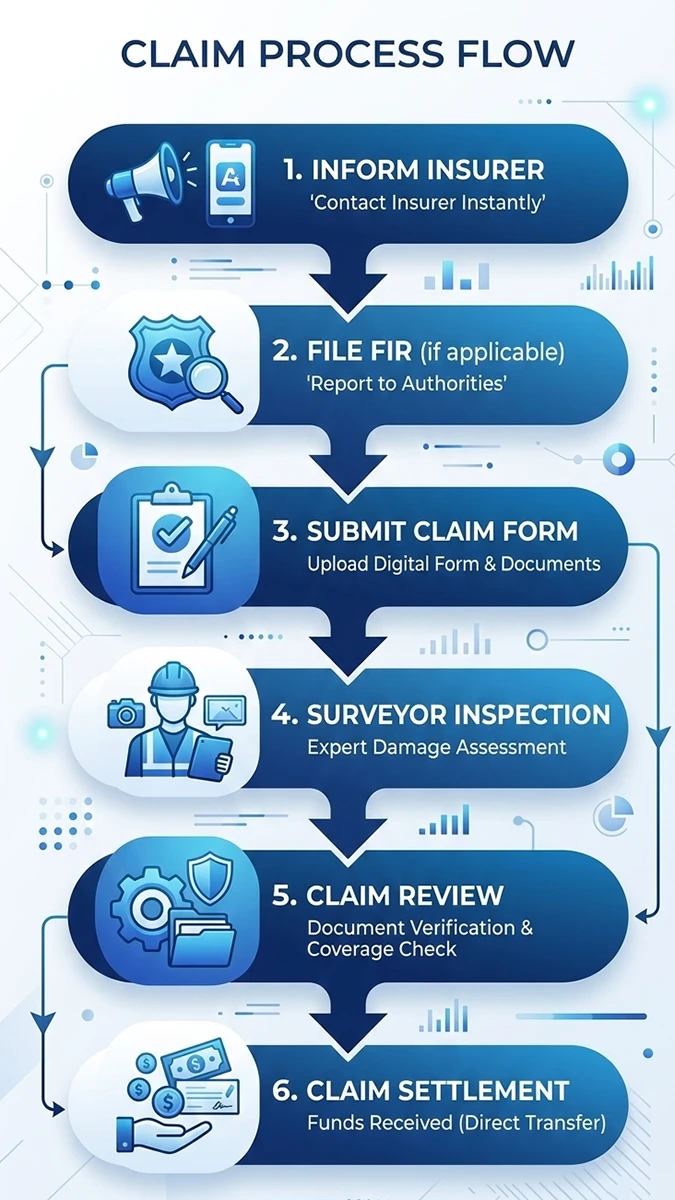
Step-by-Step Claim Process
- Inform your insurer immediately. Don’t wait. Most policies require intimation within 24 to 48 hours of the incident.
- File a police FIR if needed. Required for motor theft, house burglary, or any criminal act.
- Fill out and submit the claim form. Attach all required documents: policy copy, photos, bills, medical reports.
- Insurer deputes a surveyor. For motor and home claims, a licensed surveyor inspects the damage.
- Claim is approved or queried. Insurer may ask for additional documents before approving.
- Settlement. Cashless (directly to hospital or garage) or reimbursement to your bank account.
Common Reasons Claims Get Rejected
These are the ones that catch people off guard. Read them before you need them.
- Non-disclosure of a pre-existing condition at the time of buying a health policy.
- Policy lapsed because the renewal premium wasn’t paid on time.
- Claim filed after the waiting period restriction in a health insurance policy.
- Incident not covered under the policy terms (e.g., flooding caused by negligence, not natural disaster).
- Inflated or fraudulent claim documentation.
Claim Ratios: What to Check Before You Buy
The Incurred Claim Ratio (ICR) shows the percentage of premiums collected that were paid out as claims. Too low means the insurer rejects too many. Too high means the insurer may not be financially stable.
The Claim Settlement Ratio (CSR) shows the percentage of claims actually settled. Choose an insurer with a CSR above 95%. Verify CSR data for all IRDAI-registered insurers at the IRDAI official list of registered insurers and CSR data.
How to Choose the Right General Insurance Policy
Most people asking what is general insurance policy they should buy pick the cheapest one. That’s a mistake. The cheapest policy often has the lowest claim settlement ratio, the smallest network, and the most exclusions.
Pre-Purchase Checklist
Go through this before paying any premium.
- Identify what you’re protecting: health, vehicle, home, or travel.
- Compare at least 3 policies on IRDAI-licensed comparison portals.
- Check the sum assured against your actual risk exposure, not just a round number.
- Read the exclusions section first. Not the inclusions. The exclusions.
- Verify the cashless network: hospitals for health, garages for motor.
- Check the CSR of the insurer. Anything below 95% deserves a second look.
- Understand the deductible and co-pay terms. These are what you pay before the insurer kicks in.
- Look for useful riders: zero depreciation for motor, OPD cover for health.
General Insurance for Different Life Stages
Your insurance needs change as your life changes. Here’s a quick map.
| Life Stage | Recommended Coverage |
|---|---|
| Student | Basic health cover + travel insurance |
| Young professional | Health insurance + motor insurance |
| Married with family | Family floater + home insurance + term life |
| Senior citizen | Senior citizen health plan + personal accident cover |
| Business owner | Commercial insurance + group health for employees |
Top General Insurance Companies in India (2026)
India has over 30 general insurance companies. Here are the most established ones across public and private sectors. Check the full updated list at the IRDAI’s official register of general insurance companies.
Public Sector Companies
These are government-owned and among the oldest insurers in India.
- New India Assurance Co. Ltd. Founded 1919. Present in 25 countries. India’s largest general insurer by premium.
- Oriental Insurance Company Ltd. Focus on rural and agricultural insurance.
- National Insurance Company Ltd. Strong in health and motor segments.
- United India Insurance Company Ltd. Known for competitive premiums in motor insurance.
Major Private Sector Companies
- ICICI Lombard General Insurance. India’s largest private non-life insurer.
- HDFC ERGO General Insurance. Known for high claim settlement ratio.
- Bajaj Allianz General Insurance. Strong network across health and motor.
- Tata AIG General Insurance. Popular for travel and home insurance.
- SBI General Insurance. Backed by State Bank of India’s network.
- Go Digit General Insurance. India’s fastest-growing digital insurer.
- Reliance General Insurance. Wide product range across segments.
Specialized Health-Only Insurers (SAHI)
These companies exclusively offer health insurance products.
- Star Health Insurance. India’s largest standalone health insurer.
- Niva Bupa (formerly Max Bupa). Known for comprehensive family health plans.
- Care Health Insurance (formerly Religare). Competitive in senior citizen plans.
Common Myths About General Insurance
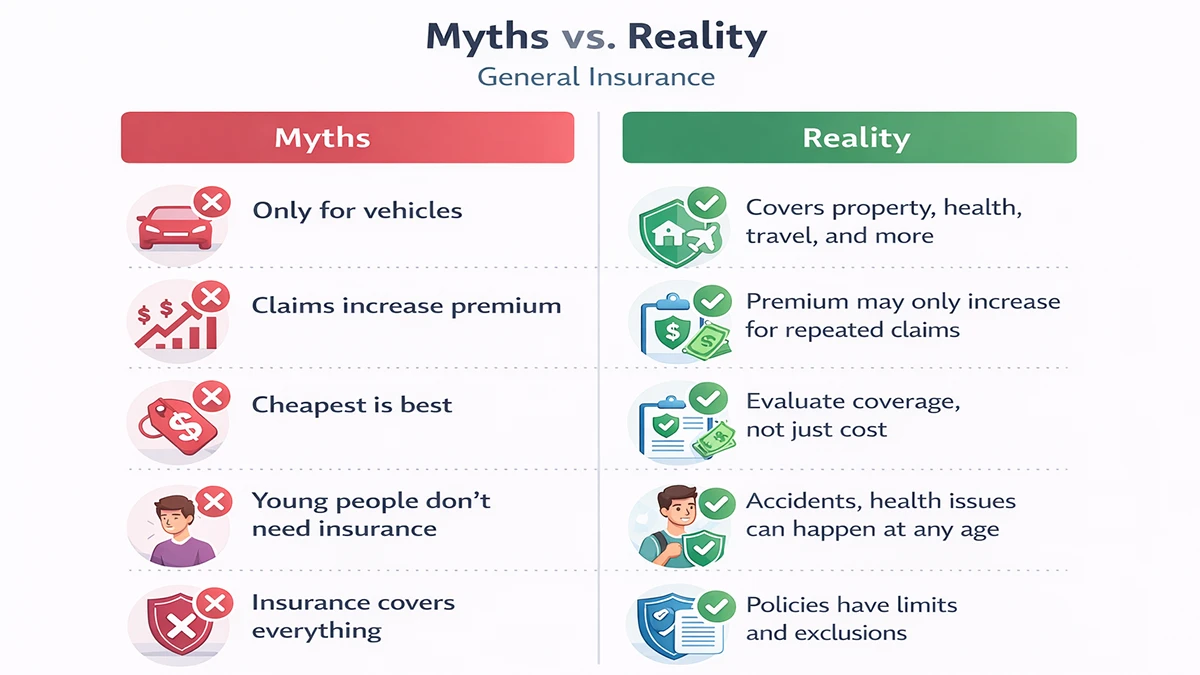
These myths cost people real money every year.
Actually, Myth 5 is the one that causes the most claim shocks. Most people find out about their policy’s exclusions only when they’re trying to file a claim. That’s the worst possible time to read the fine print.
Myth 1: General insurance is only for vehicles
Reality: It covers health, home, travel, business assets, crops, pets, gadgets, and more. Motor insurance is just the most visible type.
Myth 2: Making a claim will raise my premium drastically
Reality: A small claim might cost you your No Claim Bonus. But it won’t automatically spike your premium. It depends on your insurer’s policy and the claim amount.
Myth 3: Cheapest premium equals best policy
Reality: A lower premium often means a smaller network, fewer covered conditions, or a higher deductible. You’ll notice the gap when you file a claim.
Myth 4: I’m young and healthy, I’ll get health insurance later
Reality: Buying health insurance early means lower premium, no waiting period surprises, and more coverage options. Most serious illnesses have a 2 to 4 year waiting period in new policies.
Myth 5: General insurance covers everything
Reality: Every single policy has exclusions. Pre-existing conditions, intentional damage, wear and tear, and war-related damage are almost universally excluded. Always read the exclusions first.
Tax Benefits of General Insurance in India
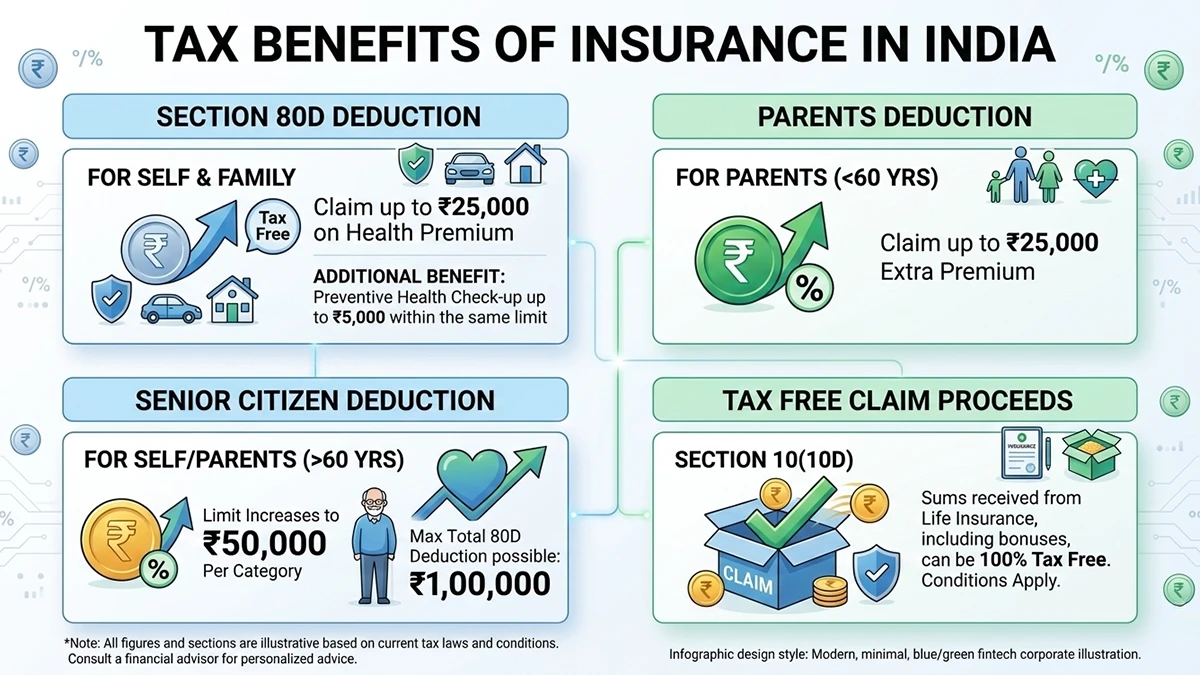
General insurance isn’t just about protection. It also gives you legal tax savings under the Income Tax Act.
Section 80D: Health Insurance Premium Deduction
This is the most used tax benefit in general insurance.
- For yourself and your family: Up to Rs 25,000 deduction per year.
- For parents below 60: Additional Rs 25,000.
- For senior citizen parents: Additional Rs 50,000.
- Maximum combined deduction: Up to Rs 1,00,000 per year.
Home Loan Borrowers and Section 80C
Home insurance premiums can be claimed under Section 80C in specific conditions if you have an active home loan. See how Section 80C deductions work across different investment options for complete eligibility details.
Business Insurance Premiums
If you run a business, the premiums you pay for commercial insurance policies are eligible as business expenses under Section 37(1) of the Income Tax Act. They reduce your taxable income directly.
Claim Proceeds Are Tax-Free
Any settlement amount you receive from a general insurance claim is tax-free under Section 10 of the Income Tax Act. It’s not added to your income.
Frequently Asked Questions
What is general insurance in simple words?
What is general insurance, simply put: it’s a policy that pays you back when something unexpected damages your car, health, home, or valuables. You pay a small premium every year. The insurer compensates you if a covered loss happens. It does not cover death (that’s life insurance).
What are the 4 main types of general insurance?
The four most common types are health insurance (covers medical expenses), motor insurance (covers vehicles), home insurance (covers property and contents), and travel insurance (covers trip-related losses). India also has marine, commercial, and several niche types.
What are the 7 principles of general insurance?
The seven principles are: indemnity, insurable interest, utmost good faith, subrogation, contribution, proximate cause, and loss minimization. Of these, utmost good faith (full disclosure at purchase) is the most commonly violated, and the top cause of claim rejections.
What is the difference between general and life insurance?
General insurance covers your assets and health for a short term, usually 1 year. Life insurance covers your life (or pays your family if you die) for a long term. General insurance is about restoring actual losses. Life insurance is about a guaranteed payout.
Is health insurance a type of general insurance?
In India, health insurance is classified under general insurance by IRDAI. It is a non-life insurance product. Standalone health insurance companies (SAHI) focus exclusively on health products but are still regulated by IRDAI.
Is general insurance mandatory in India?
Motor third-party insurance is legally mandatory under the Motor Vehicles Act, 1988. All other general insurance types are voluntary but strongly recommended. The financial risk of going uninsured on health, home, or business is entirely your own.
How long does a general insurance policy last?
Most policies run for 1 year and must be renewed annually. Multi-year options are available for motor and home insurance, sometimes with a small discount. Unlike life insurance, there’s no maturity benefit or savings component.
Can I buy multiple general insurance policies?
ou can hold multiple policies simultaneously. But remember the principle of contribution: if two policies cover the same risk, each insurer pays only its proportionate share. You can’t double-claim and profit from one loss.
How to Pick Your First Policy Today
Now you know what is general insurance, how it works, and what it covers. The next step isn’t research. It’s action.
Start with the one gap that exposes you the most right now. No health cover? That’s the most urgent. Driving without comprehensive motor insurance? That’s next.
Check the CSR of the insurer you choose before buying. It takes two minutes and is the single best filter to avoid an insurer who will fight your claim later. Verify at the IRDAI consumer portal for policy verification and grievance filing.
And if you already have a policy, pull it out today and read the exclusions section. Most people never do. The ones who do almost always change something about their coverage.
Bottom Line
General insurance is the difference between a financial setback and a financial disaster. A single accident, hospitalization, or natural event can wipe out years of savings in hours. The right policy doesn’t just pay claims—it lets you sleep knowing that if something breaks, your money won’t. Pick your coverage based on what you actually own and value, not what’s cheapest, and you’ll never have to choose between your health and your savings when it matters most.
Disclaimer: This article is for informational purposes only. Consult a licensed IRDAI-registered insurance advisor before purchasing any policy. Tax benefit details are based on current provisions and may be subject to amendment.