
- What Pregnancy Health Insurance Covers in India
- Eligibility + Waiting Period: The Basics
- Why Buying Early Is Still the Best Advice
- Already Pregnant? Your 3 Real Options Right Now
- Is a C-Section Covered by Insurance? The Full Truth
- Star Women Care Insurance Policy: The Deep Dive
- How to Claim ₹6,000 for Pregnancy: PMMVY Step-by-Step
- Best Pregnancy Health Insurance Plans Comparison (2025–26)
- Pregnancy Health Insurance Cost Guide + Tax Benefit
- Frequently Asked Questions
- Frequently Asked Questions
- Conclusion
By Deeksha | Updated: 24 March 2026 | Pregnancy health insurance
Pregnancy health insurance in India has become an essential financial tool to combat rising medical inflation and high delivery costs. This guide explores the best 2025–26 plans, highlighting critical factors like waiting periods, C-section sub-limits, and coverage for newborns. Whether you are planning ahead or already expecting, understanding these policy nuances ensures you secure the best maternity care without unexpected financial “billing room shocks.
Choosing the right pregnancy health insurance in India is no longer a luxury; it is a critical financial roadmap for growing families.
With healthcare inflation in India surging at 15% to 20% annually according to the IRDAI 2024–25 report, the cost of bringing a child into the world has shifted from a manageable expense to a significant financial event.
What cost ₹80,000 for a delivery just three years ago can easily scale to ₹1.1 lakh today.

Whether you are already expecting or just beginning to discuss family planning, understanding the mechanics of coverage, from the dreaded waiting periods to the hidden C-section sub-limits, is the only way to avoid a “billing room shock”.
This guide breaks down the essential inclusions, compares the top-rated plans for 2026, and even explains how to claim government benefits like the PMMVY.
What Pregnancy Health Insurance Covers in India
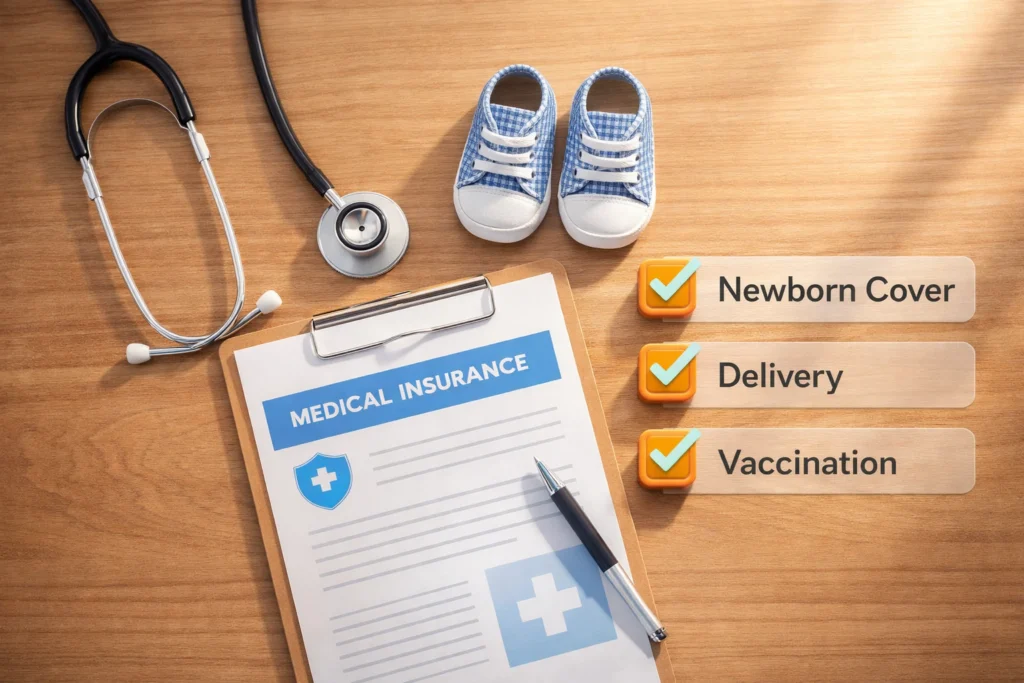
Before comparing policy premiums, you need to know exactly what is landing in your “shopping cart.” In the Indian market for 2025–26, a standard maternity benefit is designed to handle the high-velocity costs associated with both the lead-up to and the aftermath of childbirth.
Standard Inclusions
Most comprehensive plans cover the full spectrum of the maternity journey, starting with prenatal care like doctor consultations, ultrasounds, and blood tests, typically for 30–60 days before the big day. The core of the policy, however, is the delivery itself, which pays for the surgeon, anaesthetist, OT charges, and room rent for both normal and C-section procedures. Post-delivery care and newborn coverage, including NICU charges and Day 1 vaccinations like BCG and Polio, are also standard for up to 90 days in most modern products.
| What Is Covered | Details / Notes |
| Prenatal care | Doctor consultations, ultrasounds, blood tests (30–60 days pre-delivery) |
| Delivery charges | Normal & C-section: OT charges, surgeon, anaesthetist, room rent |
| Postnatal care | Check-ups and medications (60–90 days post-discharge) |
| Newborn baby cover | NICU charges, Day 1 vaccinations (BCG, Polio, Hep-B) up to 90 days |
| Pregnancy complications | Ectopic pregnancy, miscarriage requiring hospitalisation |
Standard Exclusions
Equally vital is knowing where the insurer’s “no” starts. Universally, voluntary terminations (MTP) and pregnancies that existed before you bought the policy are excluded. While Star Women Care is a rare outlier that covers IVF, most standard plans will not pay for assisted reproduction or non-allopathic treatments like Ayurveda. Congenital conditions of the newborn are also typically excluded from the maternity bucket and require separate paediatric coverage.
While most people categorize maternity benefits under healthcare, it is technically a specialized part of general insurance in India that follows specific indemnity rules.
Expert Insight: In my years of reviewing claims, the biggest mistake parents make is assuming “Newborn Cover” includes everything. If your baby is born with a congenital heart defect, your maternity benefit likely won’t touch it; you’ll need the baby added to a standard health policy immediately to cover long-term treatments.
Eligibility + Waiting Period: The Basics
Navigating the entry requirements for pregnancy health insurance requires a bit of calendar math. Most retail plans are designed for women aged 18–45, though certain niche products like Star Women Care have removed that upper age cap to accommodate later-in-life pregnancies.
Who Is Eligible
For most individual or family floater plans, you must purchase the policy before the pregnancy begins. If you are already employed, however, you have a massive advantage: corporate group insurance often has no age or pre-pregnancy restrictions. If you are currently working, your first move today should be checking your HR portal to see if maternity is an active benefit.
Waiting Period , Quick Reference Table
The “waiting period” is the single most important variable in your purchase. It is the duration you must hold the policy before a maternity claim becomes valid.
| Waiting Period | What It Means for You |
| 0 months (ongoing) | Rare: Star Women Care add-on only (requires scan reports) |
| 3 months | Future Generali Women Care (requires a 3-year policy commitment) |
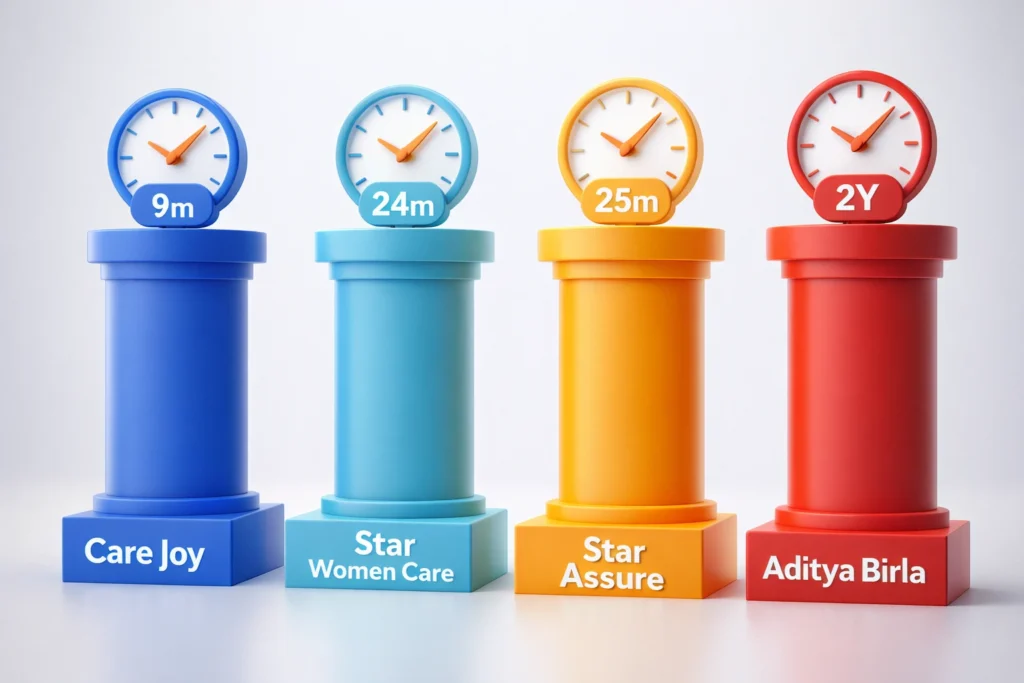
| 9–12 months | Star Women Care (9m), Care Joy (9m), Niva Bupa Aspire (12m) |
| 2 years | HDFC Ergo Optima Restore or Care Supreme add-ons |
| 0 months (corporate) | Employer group insurance , Day 1 coverage for employees |
Understanding these timelines is crucial because if you deliver even one day before the waiting period ends, the insurer will likely reject the entire claim.
Why Buying Early Is Still the Best Advice
The golden rule of pregnancy health insurance is simple: buy it when you don’t need it yet. Ideally, you should secure a policy at least 9 to 12 months before your expected delivery date to ensure you clear the waiting period hurdles.
Take the case of Ananya, a 28-year-old software engineer in Bengaluru. She purchased a family floater with a 2-year maternity waiting period right after her wedding. When she became pregnant 18 months later, she was technically “too early” for her policy. She ended up paying ₹1.2 lakh out of pocket for a private hospital delivery because she was six months short of serving her waiting period.
Buying early doesn’t just clear the clock; it locks in lower premiums while you are younger and ensures fewer “pre-existing condition” hassles during the underwriting process. The best time to sign is right after marriage or the moment family planning enters the conversation.
Already Pregnant? Your 3 Real Options Right Now
If you are reading this with a positive pregnancy test in hand, don’t panic. While most retail plans treat an ongoing pregnancy as a pre-existing condition and won’t cover it, you still have three actionable paths.
Star Health Women Care Add-on: Ongoing Pregnancy Accepted
This is the only retail plan in India that explicitly accepts an ongoing pregnancy. By submitting your 12-week and 20-week scan reports, Star Health can activate the Women Care add-on for your current pregnancy. This window usually closes after the 20-week mark, so if you are in your second month, this is a time-sensitive call you need to make.
Your Employer’s Group Health Insurance
Corporate plans are the “holy grail” for ongoing pregnancies. They cover maternity from Day 1 with zero waiting periods. Check your own benefits portal or your spouse’s, you may already be covered as a dependent.
Government Schemes
Regardless of insurance, the PMMVY provides a ₹6,000 cash benefit for the first pregnancy. If you are in a lower-income bracket, schemes like Janani Suraksha Yojana (JSY) offer free delivery at government hospitals plus cash incentives.
Is a C-Section Covered by Insurance? The Full Truth
Yes, C-sections are covered, but there is a massive catch: the sub-limit. Even if you have a ₹10 lakh policy, your insurer will likely cap the maternity payout at a much lower amount, often leaving a significant gap for you to pay.
C-Section Sub-limit Reality , What Insurance Actually Pays
With C-section rates hitting nearly 47% in India’s private hospitals, the gap between “cost” and “cover” is a real threat to your savings.
| Hospital Type | Actual C-Section Cost (2025) | Typical Insurance Sub-limit Payout |
| Metro Private (Delhi) | ₹1,50,000 – ₹2,50,000 | ₹50,000 – ₹1,00,000 |
| Tier-2 City Private | ₹60,000 – ₹1,00,000 | ₹30,000 – ₹75,000 |
| Government Hospital | ₹0 – ₹10,000 | Not applicable |
Expert Insight: Most people obsess over the “Sum Insured.” Don’t. If you’re delivering in a metro like Mumbai or Delhi, a ₹50,000 sub-limit is practically useless for a C-section that costs ₹2 lakh. Look for plans like Niva Bupa Aspire or Care Joy that push that sub-limit toward the ₹1 lakh mark.
Star Women Care Insurance Policy: The Deep Dive
Star Women Care is frequently searched because it breaks the traditional “rules” of Indian maternity insurance.
What Makes Star Women Care Unique
It is the only retail policy that accepts ongoing pregnancies through its specific add-on. Beyond that, it covers IVF and surrogacy, features that are nearly extinct in other retail products, and offers a short 9-month waiting period for new buyers.
Star Women Care vs Star Super Star
While Star Women Care is a standalone women-centric plan, the Star Super Star version allows you to add the same maternity benefits to a family floater, giving you more flexibility if you want to cover your spouse under the same policy.
How to Claim ₹6,000 for Pregnancy: PMMVY Step-by-Step
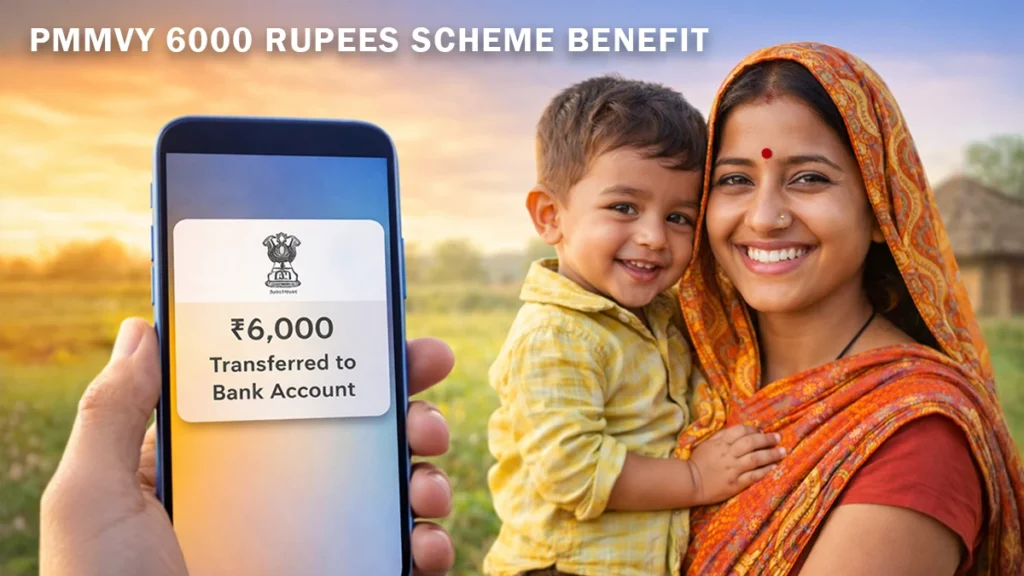
The PM Matru Vandana Yojana (PMMVY) is a central government scheme providing a ₹5,000 cash transfer for the first live birth, usually combined with a ₹1,000 JSY benefit for institutional delivery.
What Is PMMVY?
It is a benefit for all pregnant women aged 19+ for their first pregnancy, there is no income restriction.
Step-by-Step Claim Process
- Register: Visit an Anganwadi Centre (AWC) within 150 days of your LMP.
- Documents: Submit your Aadhaar, bank details, and Mother Child Protection (MCP) card.
- Instalments: You receive ₹3,000 after registration and ₹2,000 after the delivery is registered
- Official PMMVY Portal: https://pmmvy.nic.in/
Best Pregnancy Health Insurance Plans Comparison (2025–26)
Choosing a high-cover plan is only half the battle; understanding the standard health insurance claim process ensures you don’t face last-minute rejections during discharge.
| Plan Name | Waiting Period | C-Section Sub-limit | Key Unique Feature |
| Star Women Care | 9 months | Up to ₹1 lakh | Covers ongoing pregnancy & IVF |
| Future Generali | 3 months | Up to ₹70,000 | Shortest non-pregnant WP |
| Care Joy Plan | 9 months | Up to ₹1 lakh | Focus on complications & NICU |
| Niva Bupa Aspire | 12 months | Up to ₹1 lakh | Strong claims settlement ratio |
| Corporate Plan | Day 1 | Varies (₹25K–₹1L) | Best option if available |
Pregnancy Health Insurance Cost Guide + Tax Benefit
Annual premiums for a ₹5 lakh sum insured typically range from ₹8,000 to ₹15,000 for an individual, while family floaters for a young couple hover between ₹12,000 and ₹22,000.
Section 80D Tax Benefit
You can deduct up to ₹25,000 in premiums from your taxable income under Section 80D. Additionally, the GST exemption on health insurance effective late 2025 has made these plans even more affordable for the average middle-class family.
Frequently Asked Questions
Q1: Which is the best health insurance for pregnancy? It depends on your timing. For ongoing pregnancy, use Star Women Care. For future planning, Future Generali (3-month WP) or Care Joy (9-month WP) are top contenders.
Q2: Can I get insurance if I’m already pregnant? Yes, but only through Star Women Care (retail) or an employer’s group policy (corporate).
Q3: Is a C-section covered? Yes, but always check the sub-limit. You will likely pay ₹50,000 to ₹1.5 lakh out of pocket in a metro private hospital even with insurance.
Frequently Asked Questions
Which is the best health insurance for pregnancy in India?
The best pregnancy health insurance depends on the waiting period and sum insured. Top-rated plans for 2025-26 include:
Care Joy: Offers the shortest waiting period (9 months to 24 months).
Star Women Care: Best for comprehensive coverage (up to ₹1 Cr) and newborn expenses.
Niva Bupa Heartbeat: Ideal for families wanting international maternity coverage.
Aditya Birla Activ Health: Best for young couples looking for wellness-linked premium discounts.
Can I get insurance if I am already pregnant?
Yes, you can buy a health insurance policy while pregnant, but it will not cover the current pregnancy’s delivery expenses. Most insurers treat existing pregnancy as a “pre-existing condition” with a mandatory waiting period of 9 months to 4 years. To cover maternity costs, it is essential to buy insurance before conception.
Which insurance is best for a pregnant woman?
In India, Star Women Care Insurance and Care Joy are widely considered the best options. Star Women Care is popular because it doesn’t require a pre-policy medical check-up for younger ages and covers assisted reproduction treatments (IVF). For global coverage, Cigna (Global) is highly rated for prenatal and labor satisfaction.
How to claim 6,000 rupees for pregnancy in India?
You can claim ₹6,000 through the Pradhan Mantri Matru Vandana Yojana (PMMVY).
First Child: You receive ₹5,000 in two installments.
Second Child (Girl): You receive ₹6,000 in a single installment. Process: Apply at your local Anganwadi center or via the PMMVY online portal with your Aadhaar card, MCP card (Mamta card), and bank passbook.
Who is eligible for maternity insurance?
Generally, women between the ages of 18 and 45 years are eligible for maternity health insurance. However, the most critical eligibility factor is the waiting period. You are eligible for a claim only if you have completed the specific waiting period (usually 2 to 4 years) defined in your policy before the delivery date.
What is the PM Modi Pregnancy Scheme?
The PM Modi Pregnancy Scheme, officially known as the Pradhan Mantri Matru Vandana Yojana (PMMVY), is a maternity benefit program that provides financial assistance to pregnant and lactating women.
Under this scheme, eligible mothers receive:
₹5,000 for their first child (disbursed in two installments).
₹6,000 for the second child, provided the child is a girl.
The funds are transferred directly to the beneficiary’s bank account (DBT) to ensure proper nutrition and support healthcare expenses during and after pregnancy.
Conclusion
Pregnancy health insurance rewards the proactive. If you have the luxury of time, choosing a plan like Care Joy or Niva Bupa Aspire now will save you six figures later. If you are already pregnant, your immediate priority is checking your corporate policy or contacting Star Health. Finally, regardless of your insurance status, register for the PMMVY benefit, there is no reason to leave ₹6,000 on the table.
Would you like me to help you find the nearest Anganwadi Centre for your PMMVY registration or compare the specific premiums for your age?
Disclaimer: The information provided in this article is for educational purposes only and does not constitute financial or legal advice. Insurance plans, premiums, and terms are subject to change by the IRDAI and respective insurers; please read the official policy documents carefully before making a purchase.