
- What is SIP in Mutual Funds?
- Why SIP is Popular Among Beginners
- How SIP Works: A Simple Example With Real Numbers
- Things to Decide Before Starting SIP
- Step-by-Step Process to Start a SIP
- How to Choose the Right SIP Fund
- How Much Money Should Beginners Invest in SIP?
- SIP Strategies That Increase Long-Term Returns
- Common SIP Mistakes Beginners Make
- How to Track and Review Your SIP
- When Should You Stop or Change a SIP?
- SIP vs Lump Sum Investment
- Tools That Help Beginners Start SIP
- Beginner SIP Case Studies
- Frequently Asked Questions
- One More Thing Before You Start
Friday 13, 2026
Most people wait until they have “enough money” to invest. That’s the most expensive mistake in personal finance.
How to invest in SIP for beginners starts with one fact: you can begin with just ₹500 a month. A Systematic Investment Plan takes a small, fixed amount from your bank every month and puts it into a mutual fund automatically.
No timing the market. No waiting for the “right moment.” Just regular, quiet wealth building. This guide covers how SIP works, what to decide before you start, how to pick the right fund, how much to invest, and the mistakes that cost beginners the most.
How to invest in SIP for beginners starts with one simple idea: put a fixed amount into a mutual fund every month, automatically. SIP (Systematic Investment Plan) lets you start with as little as ₹500, uses rupee cost averaging to reduce market risk, and builds wealth through the power of compounding over time. You don’t need market knowledge or a large amount to begin — just a clear goal, the right fund, and the discipline to stay invested.
What is SIP in Mutual Funds?
SIP stands for Systematic Investment Plan. It’s not a fund by itself. It’s a method of investing in mutual funds: a fixed amount, on a fixed date, every month.
How to invest in SIP for beginners becomes clear once you see the mechanism: a Systematic Investment Plan takes a small, fixed amount from your bank every month and puts it into a mutual fund automatically. The fund uses that money to buy units for you. Over time, these units grow in value.
Before you start, four terms matter.
- NAV (Net Asset Value): The price of one unit of a mutual fund on a given day. Your monthly SIP buys units at that day’s NAV.
- Units: What you own in the fund. The more units you have, the more your portfolio is worth.
- AMC (Asset Management Company): The company that manages the mutual fund. Examples: HDFC Mutual Fund, SBI Mutual Fund, Mirae Asset.
- Equity vs Debt SIP: Equity SIPs invest in stocks and have higher return potential with more risk. Debt SIPs invest in bonds and are more stable with lower returns.
Why SIP is Popular Among Beginners
Three things make SIP the best entry point for new investors.
Rupee cost averaging: When markets fall, your fixed SIP amount buys more units at a lower price. When markets rise, you buy fewer units at a higher price. Over time, this averages your cost per unit and reduces the damage of market swings.
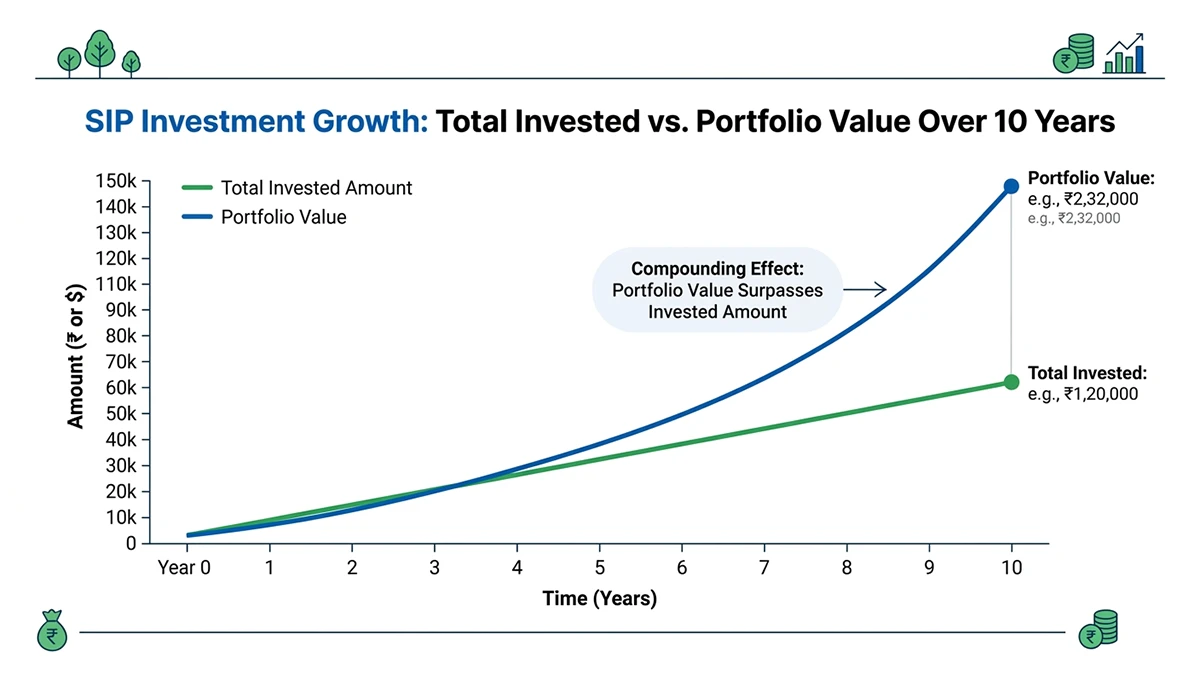
Power of compounding: Your returns start earning returns of their own. A ₹1,000 monthly SIP at 12% annual returns over 20 years doesn’t give you ₹2.4 lakh. It gives you about ₹9.2 lakh. That extra ₹6.8 lakh is compounding doing its job quietly.
Automation: Once you set up a SIP, the money moves on its own. No discipline needed. No willpower. The system does the investing for you, even on months when you forget.
And most people don’t realize that starting with ₹500 is genuinely fine. The amount matters less in year one than the habit of staying invested.
How SIP Works: A Simple Example With Real Numbers
How to invest in SIP for beginners explained through actual numbers, not theory.
Say you invest ₹1,000 every month in a mutual fund. The NAV changes each month based on the market.
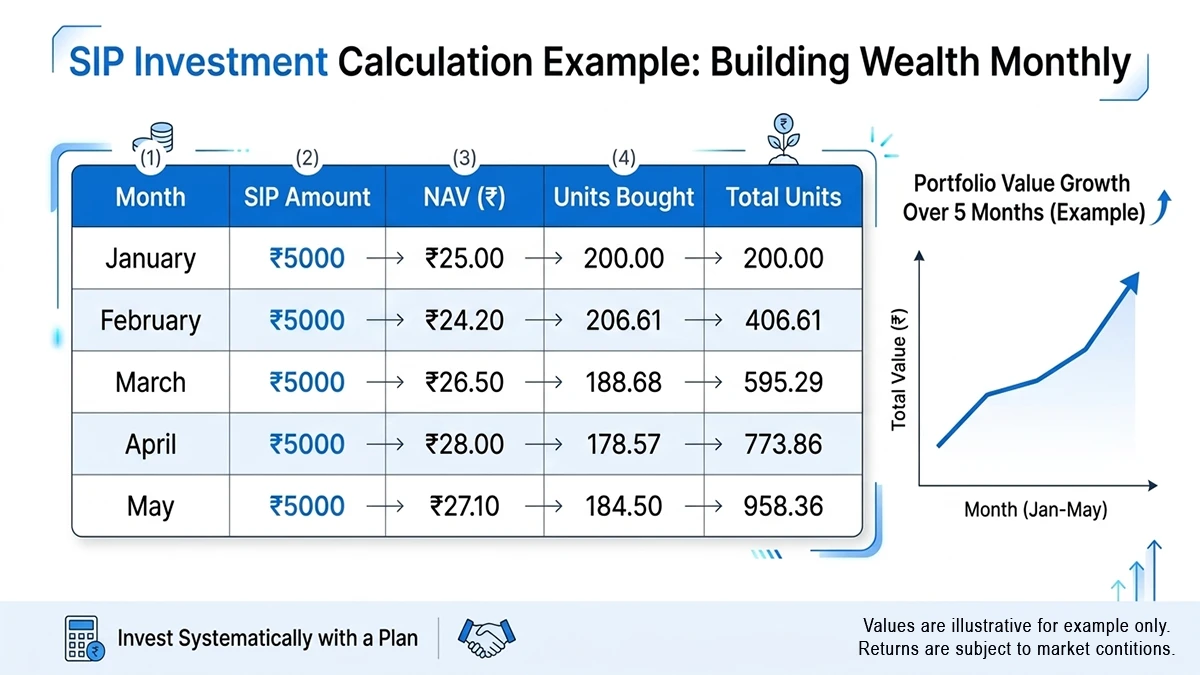
| Month | SIP Amount | NAV (₹) | Units Bought | Total Units |
| January | ₹1,000 | 50 | 20.0 | 20.0 |
| February | ₹1,000 | 40 | 25.0 | 45.0 |
| March | ₹1,000 | 45 | 22.2 | 67.2 |
| April | ₹1,000 | 55 | 18.2 | 85.4 |
| May | ₹1,000 | 60 | 16.7 | 102.1 |
Total invested: ₹5,000. Total units: 102.1. If NAV at the end of May is ₹60, your portfolio value is ₹6,126. You made ₹1,126 on ₹5,000, even though the market went down in February.
The February dip didn’t hurt you. It helped you buy more units cheaply. That’s rupee cost averaging working in real time.
Things to Decide Before Starting SIP
Jumping into a SIP without thinking through these three things is what leads to stopping early.

Define Your Investment Goal
Your goal shapes everything: which fund to pick, how long to stay invested, and how much risk you can take.
- Retirement corpus: 20 to 30 years away. High equity SIP.
- Child’s education: 10 to 15 years away. Balanced or equity SIP.
- Home down payment: 5 to 7 years away. Moderate equity SIP.
- Emergency fund top-up: 1 to 2 years away. Debt or liquid SIP.
Choose Your Investment Horizon
The longer you stay invested, the more time compounding has to work. For beginners:
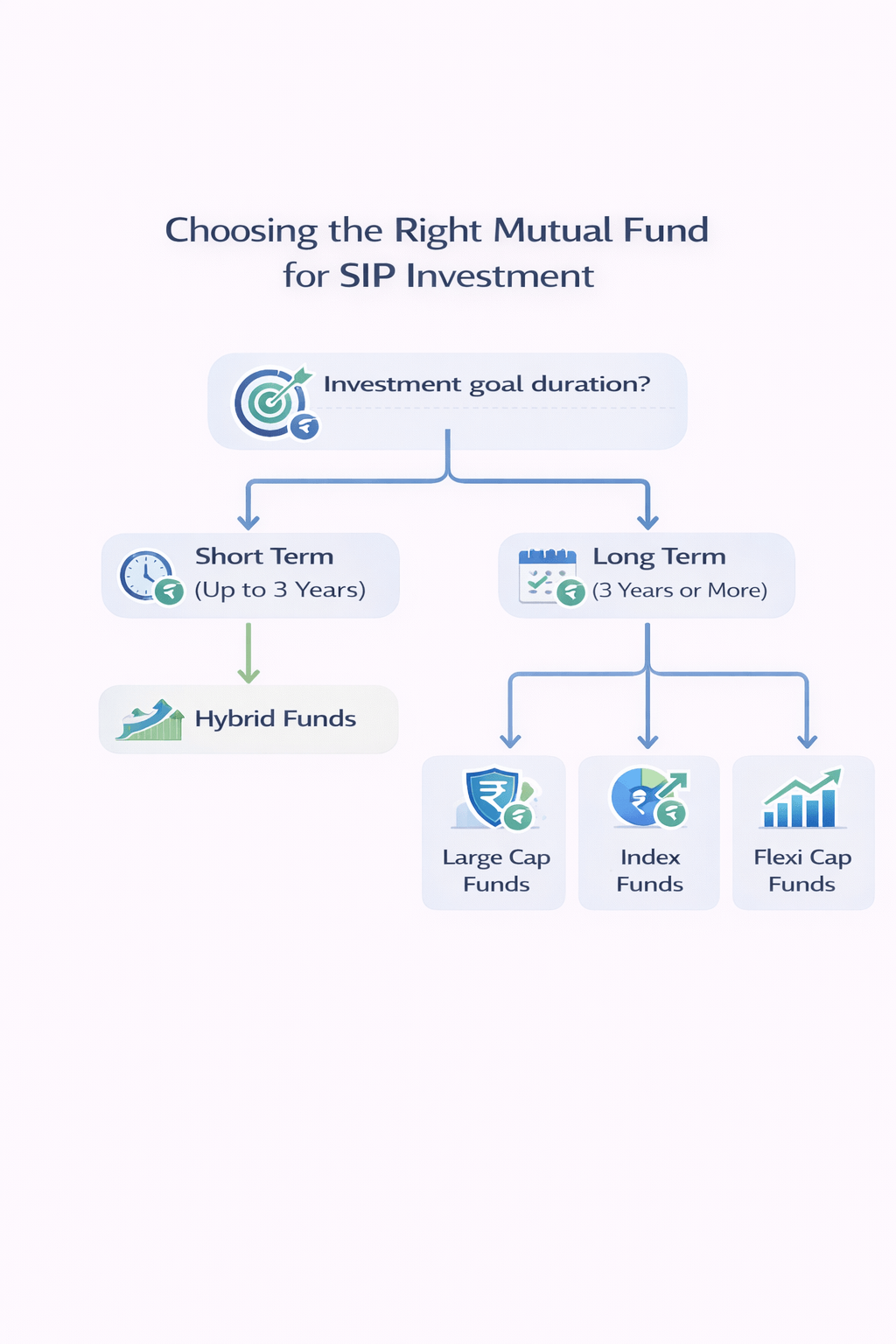
- 3 to 5 years: Debt funds or hybrid funds. Lower volatility.
- 5 to 10 years: Flexi cap or large cap equity funds. Moderate risk.
- 10+ years: Equity funds, including mid and small cap. Higher potential returns.
Understand Your Risk Level
Be honest here. A fund that drops 30% in a bad year can feel very different from what a chart shows on paper.
- Conservative: Debt funds, liquid funds. Returns around 6 to 8%.
- Moderate: Hybrid or balanced advantage funds. Returns around 9 to 11%.
- Aggressive: Pure equity funds. Returns around 12 to 15% over long periods, with more short-term swings.
Step-by-Step Process to Start a SIP
How to invest in SIP for beginners comes down to seven steps. Each one is faster than it sounds.
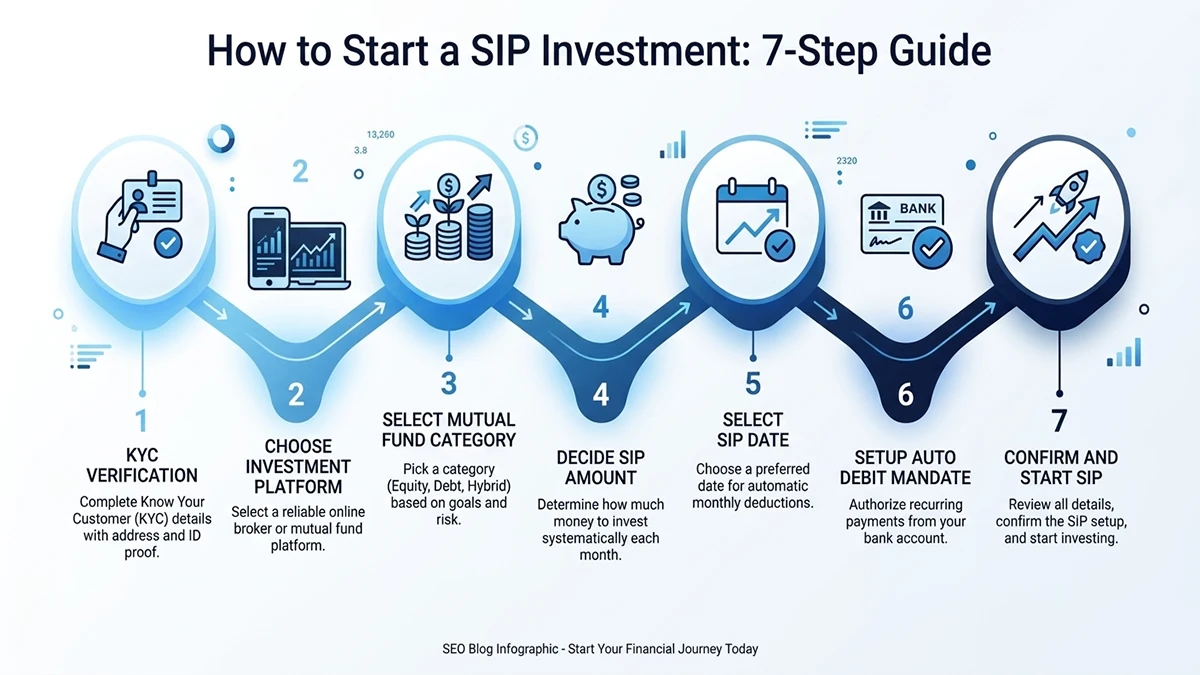
- Complete your KYC. KYC is mandatory for all mutual fund investments in India. You need your PAN card, Aadhaar, and bank details. This is a one-time process. Do it online through CAMS, KFintech, or any AMC website. It takes about 10 minutes.
- Choose an investment platform. Options include direct AMC websites (like hdfc.com/mutual-fund), registered investment apps (Groww, Zerodha Coin, Paytm Money), or your bank’s investment portal.
- Select a mutual fund category. Start with the type that matches your goal and risk level. Beginners often start with large cap funds or index funds. They’re stable, transparent, and widely tracked.
- Decide your SIP amount. Start with what you can afford to forget for years. ₹500 is the legal minimum for most funds. ₹1,000 to ₹2,000 per month is where most beginners begin.
- Select your SIP date. The 1st, 5th, or 10th of the month works for most people. Pick a date that’s a few days after your salary credit date.
- Set up the auto-debit mandate. This links your bank account to the SIP. The mandate authorizes the AMC to deduct the SIP amount automatically each month.
- Confirm and start your SIP. Review the fund name, amount, and date. Submit. Your first SIP deduction happens on the date you chose. After that, it runs automatically.
Once you’ve set up your SIP, see exactly how much your monthly investment will grow. Use our SIP calculator to run different time period and amount scenarios.
How to Choose the Right SIP Fund
This is where most beginner guides go vague. Here’s a concrete framework for how to invest in SIP for beginners fund selection.
5-Point Fund Selection Checklist
- Fund category suitability: Does it match your goal and risk level? An aggressive small cap fund is wrong for a 3-year goal.
- 3-year and 5-year performance consistency: Look for funds that rank in the top quartile of their category over multiple years, not just one good year.
- Expense ratio: The annual fee for managing your money. For equity index funds, look for under 0.2%. For actively managed equity funds, under 1% is reasonable.
- Fund manager experience: Check how long the current manager has run this specific fund. Consistency matters here.
- Fund size (AUM): Very small funds (under ₹500 crore) or very large funds (over ₹50,000 crore for mid/small cap) can create performance issues.
Beginner-Friendly Fund Categories
Three categories work well when you’re starting out.
Index funds track a market index like the Nifty 50 or Sensex. No active management, very low cost, predictable behavior. SEBI mandates full transparency on index fund holdings and costs. See SEBI’s guidelines on mutual fund expense ratios and disclosures.
Large cap funds invest in India’s 100 largest companies by market cap. More stable than mid or small cap. Good for beginners with a 5 to 7 year horizon.
Flexi cap funds can invest across large, mid, and small cap companies. The fund manager adjusts the mix based on market conditions. Good for a 7 to 10 year goal.
How Much Money Should Beginners Invest in SIP?
A simple starting point for how to invest in SIP for beginners: invest 10 to 15% of your monthly take-home salary in SIP.
For a salaried employee in Mumbai earning ₹40,000 per month, that’s ₹4,000 to ₹6,000 per month across one or two funds.
Goal-Based SIP Calculation
Scratch that. The question isn’t just “how much can I invest.” The real question is: “how much do I need to reach my goal, and how long do I have?”
Want to save ₹10 lakh in 10 years? At an assumed 12% annual return, you’d need about ₹4,347 per month.
Want to save ₹25 lakh in 15 years? At 12% annual return, that needs about ₹4,841 per month.
| Goal | Target Amount | Time | Monthly SIP (at 12%) |
| Emergency fund | ₹3 lakh | 3 years | ₹6,990 |
| Vehicle down payment | ₹5 lakh | 5 years | ₹6,110 |
| Child’s education | ₹20 lakh | 12 years | ₹6,100 |
| Retirement corpus | ₹1 crore | 25 years | ₹5,320 |
SIP Strategies That Increase Long-Term Returns
How to invest in SIP for beginners shouldn’t stop at “start a SIP.” These four strategies make a real difference over time.
Top-Up SIP (Step-Up SIP)
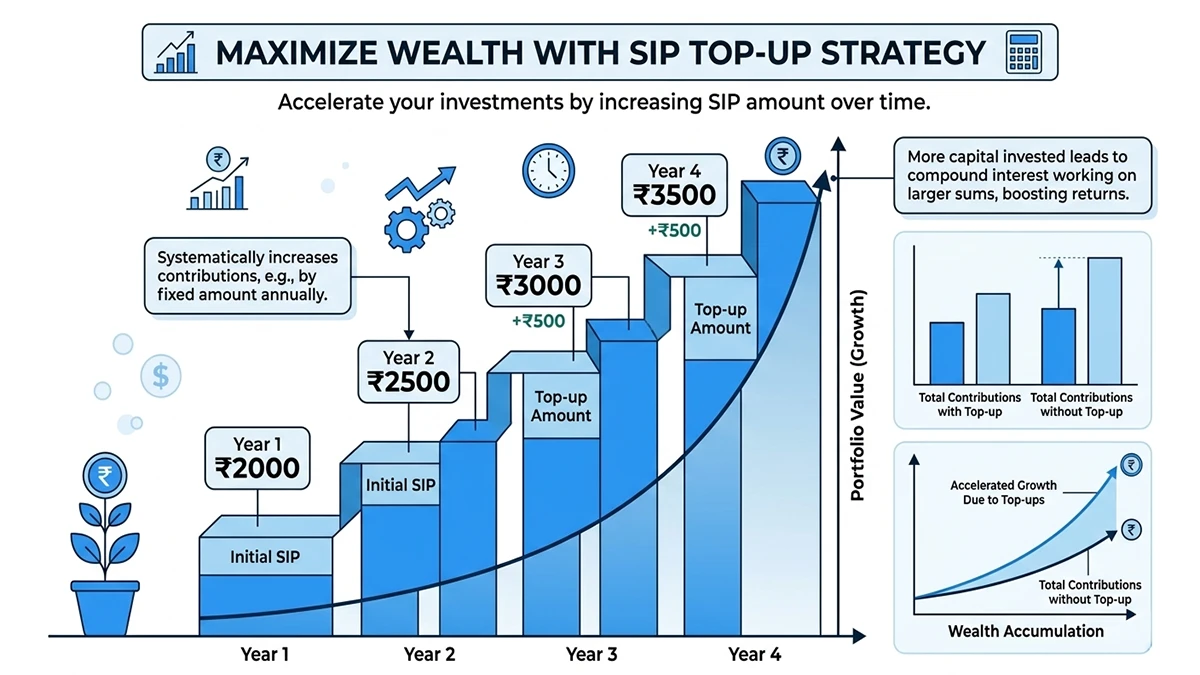
Every year, increase your SIP amount by 10 to 15%. This mirrors salary growth and keeps your investing pace aligned with your income.
A ₹2,000 SIP at 12% for 20 years gives you about ₹19.8 lakh. The same SIP with 10% annual step-up gives you about ₹48.4 lakh. Same fund. Same 20 years. Bigger outcome.
Long-Term Discipline
Don’t touch the SIP for the first 5 years. Market dips in years 1 to 3 feel uncomfortable but are exactly when rupee cost averaging works best.
The investors who stayed in during the March 2020 COVID crash and the 2022 correction are the ones who benefited most from the recovery.
Diversification Across Fund Types
Don’t put all your SIP money into one fund or one category. A balanced beginner portfolio: 60% large cap or index fund, 30% flexi cap fund, 10% debt fund for stability.
Perpetual SIP vs Fixed Tenure
Set your SIP with no end date. This removes the decision of whether to renew. You stop only when your goal is met, not when the SIP auto-expires.
Common SIP Mistakes Beginners Make

These four mistakes cost people real money when learning how to invest in SIP for beginners. The numbered list is worth reading slowly.
- Stopping SIP during a market fall. This is the most expensive mistake. When the market falls 20%, your ₹1,000 buys more units than usual. Stopping now locks in losses and misses the recovery. Keep the SIP running, or increase it.
- Choosing funds based only on recent past returns. A fund that gave 35% last year may have just been riding a sector rally. Look at 5-year and 10-year consistency, not last year’s number. SEBI requires past performance disclaimers on all fund marketing for exactly this reason.
- Starting SIP without a goal. “I’ll invest and see what happens” leads to cashing out at the first dip. A goal ties you to the investment emotionally. “This money is for my daughter’s college in 2033” is harder to touch than “this money is in a mutual fund.”
- Checking portfolio value every day. SIP returns build over years, not days. Checking daily is like watching a seed after planting it. You’ll see nothing but soil. Check every 6 months. Review annually.
How to Track and Review Your SIP
Review your SIP portfolio once every 6 months for the first two years. After that, once a year is enough.
When you review, check three things.
- Fund performance vs its category average: If your large cap fund consistently underperforms the Nifty 50 index, consider switching.
- Consistency of returns: One bad year is normal. Two or three consecutive underperforming years may be a signal to exit.
- Portfolio allocation: Over time, one fund may outperform and become too large a share. Rebalance if one fund crosses 60% of your total SIP holdings.
When Should You Stop or Change a SIP?
Three situations justify stopping or switching a SIP when you understand how to invest in SIP for beginners properly.
- Goal achieved: If your target amount is reached before the planned date, it’s fine to stop and redeem. You succeeded.
- Consistent fund underperformance: If your fund has underperformed its benchmark index and category average for 3 consecutive years, switch to a better fund in the same category.
- Portfolio rebalancing: As your life stage changes, your risk level should change too. A 30-year-old’s aggressive equity SIP may need to shift toward debt funds by age 50.
SIP vs Lump Sum Investment
Beginners often ask whether to invest a lump sum or start a SIP. The honest answer depends on timing and temperament.
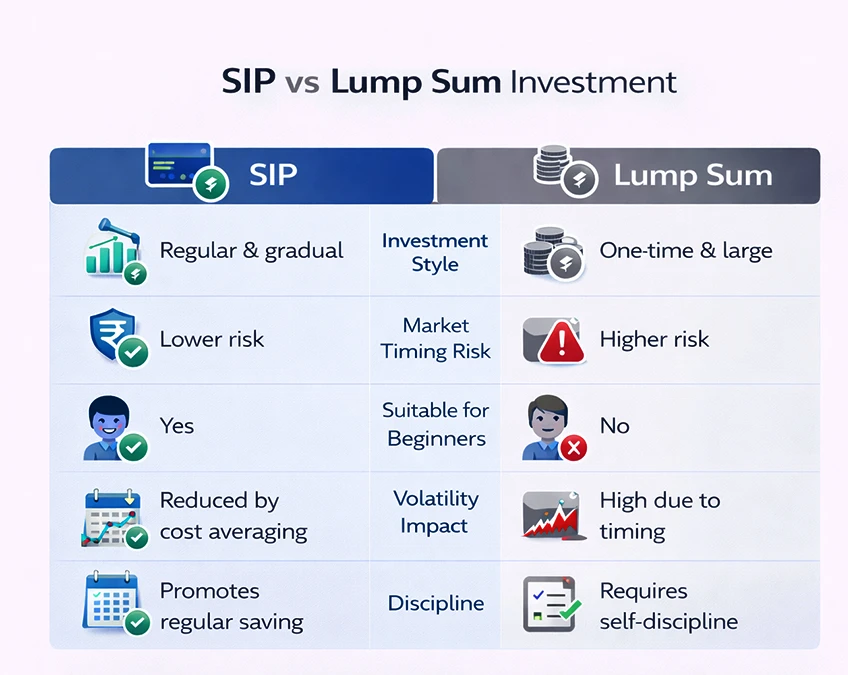
| Feature | SIP | Lump Sum |
| Best for | Regular income earners | One-time windfall |
| Market timing required | No | Yes, ideally |
| Risk spread | Over time | Concentrated at one point |
| Compounding start | Gradual | Immediate on full amount |
| Suitable for beginners | Very suitable | Requires more market knowledge |
| Minimum investment | ₹500/month | Usually ₹1,000 to ₹5,000 |
| Discipline required | Low (automated) | Moderate |
For most salaried beginners, SIP wins on every practical factor. Lump sum can work when markets have just corrected significantly and you have idle savings to deploy.
Tools That Help Beginners Start SIP
Three tools make the SIP process much easier for new investors.
SIP Calculator
Enter your monthly amount, expected return, and time period. It instantly shows your projected corpus. Run multiple scenarios: what if I increase by ₹500? What if I invest for 15 years instead of 10?
Mutual Fund Comparison Tools
SEBI-registered platforms like MF Central and AMC websites let you compare funds side by side on returns, expense ratios, and risk ratings. Access the official platform at MF Central, the joint platform by CAMS and KFintech for mutual fund tracking.
Investment Tracking Apps
Once your SIP is running, apps like CAMS Online, MF Central, or your AMC app let you track total invested amount, current value, and returns in one place.
Beginner SIP Case Studies
Real numbers show how to invest in SIP for beginners translates into actual rupees across different scenarios.
Case Study 1: ₹2,000 Monthly SIP for 15 Years
A 28-year-old in Pune starts a ₹2,000 monthly SIP in a large cap equity fund. Assumed annual return: 12%.
- Total invested: ₹3.6 lakh
- Estimated corpus at age 43: ₹10 lakh
- Gain: ₹6.4 lakh on ₹3.6 lakh invested
The money more than doubled. Not because of a brilliant fund pick. Because of 15 years of patience.
Case Study 2: Step-Up SIP Strategy
Same 28-year-old, but steps up the SIP by 10% every year starting at ₹2,000.
- Total invested: About ₹7.7 lakh over 15 years
- Estimated corpus: About ₹26 lakh
- Gain: Nearly ₹18 lakh
The step-up strategy doesn’t feel like much year to year. The difference after 15 years is dramatic, and it’s honestly hard to believe until you see it.
Case Study 3: The Investor Who Stopped During a Market Crash
Two investors start ₹5,000 monthly SIPs in January 2020. When COVID hits in March 2020 and markets fall 38%, one investor stops the SIP. The other keeps it running.
By December 2021, the Nifty 50 had recovered and hit new highs. The investor who stopped missed buying units at the lowest NAV prices of the decade. The investor who continued saw their average cost per unit drop sharply during the dip, then rise with the recovery.
Stopping SIP during fear is the single most common and most costly beginner mistake.
Frequently Asked Questions
What is the minimum SIP amount in India?
Most mutual funds allow SIPs starting at ₹500 per month. Some funds have a minimum of ₹1,000. There’s no maximum limit. You can start with ₹500 and step up as your income grows.
Can I stop SIP anytime?
You can pause or stop a SIP at any time with no penalty. Just log into your AMC account or app and submit a stop request. Stopping doesn’t mean you lose your existing units. They stay invested until you choose to redeem them.
Is SIP safe for beginners?
SIP in equity mutual funds is subject to market risk. There’s no guarantee of returns. But SIP reduces risk through rupee cost averaging and time diversification. For very conservative investors, debt fund SIPs carry significantly lower volatility than equity SIPs.
Can SIP give guaranteed returns?
No mutual fund SIP can guarantee returns. Any agent promising guaranteed returns on a mutual fund SIP is misleading you. SEBI’s regulations explicitly prohibit guaranteed return claims on market-linked products. See SEBI’s investor awareness guidelines on mutual fund risks.
What happens if a SIP payment fails?
If your bank account doesn’t have enough balance on the SIP date, the payment fails for that month. Most AMCs allow 2 to 3 missed payments before pausing the SIP. Your existing units are not affected.
Can I increase my SIP amount later?
You can increase your SIP amount at any time by starting a new SIP in the same fund for the additional amount. Many platforms also offer a step-up SIP option that automatically increases the amount by a fixed percentage each year.
One More Thing Before You Start
The best time to start how to invest in SIP for beginners was 10 years ago. The second best time is this month.
Pick one fund. Start with ₹500 or ₹1,000. Set it up on auto-debit. Then leave it alone.
Review it in 6 months. Increase it when you get a raise. Don’t stop it when the market falls. That’s the entire strategy.
Disclaimer: Mutual fund investments are subject to market risks. Read all scheme-related documents carefully before investing. This article is for educational purposes only and does not constitute investment advice. Consult a SEBI-registered investment advisor for personalized guidance.